(DALTON, Georgia) - Not only is AstroTurf® the leading innovator for sports turf systems, it is also best positioned to supply customers with guaranteed on-time delivery of AstroTurf® fields, even with its wide array of turf fiber colors, textures and shapes. This is especially important during the summer's busy installation period.
Through in-house extrusion, knitting, tufting, logo-cutting, urethane coating, and by working closely with well-established, dependable suppliers, AstroTurf® is fully capable of meeting deadlines without having to resort to component substitutions or incompatible fiber mixtures. According to AstroTurf®, fiber shortages, even in white and light green, are simply not part of its business model.
"We have the resources, skills, and experience to meet almost any supply challenge," said AstroTurf® President, Bryan Peeples. "In fact, we are so well-prepared that we can easily pick up the slack of others--to step in right now if competitors fall short-- and get projects done on time."
In terms of faster installation, one of AstroTurf®’s key advantages is its ability to prefabricate entire fields; that is, to inlay in the factory, most game lines, numerals, arrows, hash marks and end zone letters.
"This patented prefabrication process enables us to speed up installations significantly, sometimes by weeks, while improving finished quality," continued Peeples.
While other companies are dependent on components shipped from abroad, especially fiber, AstroTurf® is American-owned and American-managed, with most, if not all, components made in the USA.
"We haven't had to inform our sales reps that we can't provide certain fiber styles or colors that have been promised to their customers," said Peeples. "We plan better than that."
AstroTurf® makes most of its fibers and backings in its Georgia production facility and sometimes buys from an industry supplier within 100 miles. This allows AstroTurf® to easily provide things like multiple colors for lines, letters and logos; light and dark green for alternating turf panels (to simulate mown fields; and even tweeds (multiple colors in the same tufting needle).
But the last thing AstroTurf® wants to do is improperly mix fibers. This is a major turf sin, at least to Peeples. "Some companies think it's okay to make colored lines and other markings out of one kind of fiber, while praising the characteristics of and using a different fiber for the green turf,” he said. “We don't."
Fibers that wear at different rates can spell disaster. "Frankly," said Peeples, "if the green fiber is a different shape, and made with a different resin, it will resist wear and sunlight differently from the white, yellow, red or other fiber. Anyone who has had a turf field with 'disappearing white lines' knows exactly what I am talking about."
At AstroTurf®, quality and performance are more important than marketing hype. And so is proper planning and execution.
"We know that clients want a positive experience buying and building their turf field," concluded Peeples. "And getting what they actually paid for is certainly a key part of that experience."
About AstroTurf®
For many athletes and sport enthusiasts, the AstroTurf® brand has redefined the way the game is played. AstroTurf® offers advanced, state-of-the-art, multi-sport, and specialized synthetic turf systems with proprietary engineered technologies, leveraging a vertically integrated manufacturing system. A growing number of high schools, colleges, professional sports teams and municipalities select AstroTurf®-branded products for their premium quality, technical superiority, and safety. To learn more, visit www.astroturfusa.com. You can also check out AstroTurf® on Facebook at http://www.facebook.com/#!/pages/AstroTurf/124352067595110.
Thursday, July 28, 2011


Tuesday, July 19, 2011
The University of Tennessee and AstroTurf Open Center for Athletic Field Safety


(KNOXVILLE, Tenn.) – From the little leagues to the big leagues, injury prevention and performance are key issues in today’s sports world. Turfgrass scientists at the University of Tennessee Institute of Agriculture and AstroTurf® have partnered on a research program to address these problems.
The University of Tennessee and AstroTurf® dedicated the Center for Athletic Field Safety (CAFS) this week. The center is a one-of-a-kind facility dedicated to researching the performance and safety of natural and synthetic turf surfaces used on athletic fields. It represents the single largest athletic field research effort ever undertaken. Ceremonies were held at the research site located at the UT Institute of Agriculture’s East Tennessee AgResearch and Education Center in Knoxville, Tennessee.
“Great universities and public/private partnerships provide ideal solutions that make a difference in people’s lives; in this case, the lives of athletes,” Dr. Joe DiPietro, President of the University of Tennessee told a capacity crowd as they overlooked 60 to-scale miniature athletic fields. “We wouldn’t be here today if it weren’t for the Peeples family and AstroTurf®,” he said.
“This is a very important day for me and my family,” Bryan Peeples, President of AstroTurf®, said. “Involvement in the center gets to the core of what we are all about. Like UT, we are in the solutions business for the textile and synthetic turf industries. As soon as we can get these research findings out, AstroTurf® and others on the open market can use this information to make safer fields for athletes.”
University of Tennessee Head Football Coach Derek Dooley was on hand and echoed Peeples’ sentiments.
"I think it's a real tribute to what our university's all about," Dooley said. "It's finding solutions, taking your intellectual capacity, using the university to find solutions for America, and that's what we're doing."
“Our goal is to make fields safer at all levels of play. This center is a canvas for collaboration, affecting not only turfgrass study but areas of study such as biomechanics and human kinetics on a national level,” said Dr. John Sorochan, Co-Investigator and Associate Professor of Plant Science.
The two-acre Center for Athletic Field Safety aims to make a long-term difference. While determining the safety and performance of synthetic turf products compared to various natural turfgrass systems, UT turfgrass scientists will also monitor these relationships over time. Additionally, they will evaluate the
environmental impacts of each system. The research should lead to the development of new, more accurate methods for testing the safety and performance of all synthetic turf systems.
“Injuries are a huge concern in all athletics. The CDC has shown in studies that $49 billion is spent every year in medical and legal expenses due to injuries affecting children under 14,” said Dr. Jim Brosnan, Co-Investigator and Assistant Professor of Plant Science.
“Studies have shown that 25 percent of injuries that occur in athletics are potentially related to the conditions of the playing surface, while others have shown 50 percent of all sports injuries are preventable. We need to learn more about how athletes interact with playing surfaces.”
Natural surfaces are planted with Bermuda grass, Kentucky bluegrass and others. Both mechanical and human studies will be performed to create “real play” conditions. The research will be scientifically based for statistical analysis. In addition, the geographic location of the site will enable scientists to conduct research on a variety of surfaces from both cool- and warm-season climates. The unique outdoor research facility comprises 60 small-scale athletic research fields constructed from a variety of playing surfaces. UT turfgrass scientists will compare the safety and performance of synthetic playing surfaces to natural grass surfaces. Field qualities will range from those employed for professional–level sports to surfaces used by schools, public parks and recreation fields.
The UT Center for Athletic Field Safety will also further education for University of Tennessee students, enabling UT Plant Sciences faculty to add another level to the curriculum to train and educate future sports turf practitioners.
It was clear that this center will have a much anticipated impact. The event was attended by dignitaries such as Coach Dooley, Washington Nationals Vice President Bob Boone, and NFL Players Association Assistant Executive Director Clark Gaines, among others.
The importance of this research was underscored by concluding remarks from NFL player Eric Berry.
“As a football player, I trust the fields that I play on to respond to my movement, stops and changes of direction. As I’ve learned first-hand, an unsafe field can quickly result in loss of performance or injury. When I partnered with AstroTurf® in the summer of 2010, I learned about what makes a safe surface from the soil up. Whether natural turf or artificial, researching safer playing surfaces is something I believe in whole-heartedly. With the support of the University of Tennessee and AstroTurf®, I can’t wait to see how students and faculty are able to advance the safety of athletic surfaces. Congratulations on dedicating this one of a kind facility,” said Berry.
About The University of Tennessee Institute of Agriculture
The University of Tennessee Institute of Agriculture provides instruction, research and public service through the UT College of Agricultural Sciences and Natural Resources; the UT College of Veterinary Medicine; UT AgResearch, including its system of 10 research and education centers; and UT Extension with offices in all 95 Tennessee counties. The Tennessee Turfgrass team members have developed turfgrass management programs for sports field managers and have served as consultants to the National Football League, Major League Baseball, the PGA of America and professional soccer teams. They advise and consult internationally with sports field managers for cricket, soccer, football, golf, baseball and Olympic venues. For more information on UT’s turfgrass program, visit http://www.turf.tennessee.edu/ or http://www.tennesseeturfgrassweeds.org/
About AstroTurf®
For many athletes and sport enthusiasts, the iconic AstroTurf® brand has redefined the way the game is played. The company offers advanced, state-of-the-art, multi-sport and specialized synthetic turf systems with proprietary engineered technologies, leveraging a truly vertically integrated manufacturing system. A growing number of high schools, colleges, professional sports teams and municipalities continue to select AstroTurf®-branded products for their premium quality, technical superiority and safety. Recent innovations from AstroTurf® include GameDay Grass™ 3D with RootZone®, a polyethylene/nylon hybrid system which most closely replicates natural grass; and AstroFlect™ technology which significantly reduces turf surface temperatures. To learn more, visit www.astroturfusa.com
Go here and "like" the AstroTurf Facebook page.
http://www.facebook.com/#!/pages/AstroTurf/124352067595110
If you would like additional photographs, please email Connie Geddings at geddin00@utk.edu
Monday, July 11, 2011
THE OHIO STATE UNIVERSITY BASEBALL TEAM SELECTS ASTROTURF
(COLUMBUS, Ohio) - “THE” Ohio State University has decided to play its baseball games on “THE” premiere surface in all of sports.
The Buckeyes will be playing on an all new AstroTurf® GameDay Grass™ 3D52 Extreme surface beginning in 2012.
Head Coach Greg Beals, in announcing the decision, said the two primary reasons were to be able to practice and play more often in more types of weather. Other factors influencing the decision were the playability and consistency of the artificial surface.
Beals said the Big Ten school has no practice field, so the game field at Bill Davis Stadium also served as the practice field.
“The new AstroTurf® field will allow us to get that much-needed practice time and be able to play in virtually any condition.”
Beals, who became the Buckeyes head coach last June, said he became an expert on artificial surfaces during the process. OSU facilities staff assisted in the process, but ultimately, Beals made the decision.
The coach and staff visited several fields made by different companies, but selected AstroTurf® after visiting the baseball field at Duke University and the infield practice surface at the Port Charlotte, Florida facility which serves as the Spring Training base for the Tampa Bay Rays.
“I noticed that when I talked to coaches who played on AstroTurf®, they talked about why they liked the brand. Coaches who had other types of fields liked those fields, but just talked about the field and not the company,” said Beals. “Rich Jordan and Matthew Boggs from AstroTurf® listened first and that was the key. They didn’t try to sell us a standard field. They built a field around our specific needs.”
The new surface will feature an all-new fiber combination called Extreme. The field will combine a monofilament Horseshoe fiber with a slit film product. The Horseshoe fiber has an Omega-shape, which is more resilient and bounces back, staying upright longer. It also reflects less light and heat. The slit film offers the ultimate in durability. The field features 52 ounces of fiber per square yard.
The field will also have a nylon RootZone™, a thatch layer which holds the sand and rubber infill in place for less splash and migration, making for a more consistent playing surface.
“The look and feel of grass, the encapsulation of the infill, and the speed and play provided by the fiber weight made this the best product for us,” said Beals.
The decision by the Buckeyes is part of a growing trend toward synthetic turf in baseball. OSU joins Duke, Wake Forest, Wichita State, and others with AstroTurf® fields. AstroTurf® is the Official Synthetic Turf of Major League Baseball and is used by the Tampa Bay Rays and the Toronto Blue Jays.
The Buckeyes were able to get the field, thanks in part to a generous donation from New York Yankees star Nick Swisher, a former Buckeye. While there, Swisher was the Big Ten Freshman of the Year in 2000, won two Big Ten Championships, and was a two-time All Big Ten selection. He was the number one draft pick of the Oakland As. Swisher has been an All-Star and won a World Series in 2009 with the Yankees.
The new field will be called Nick Swisher Field.
“Nick is all about player development and guys getting on the field to make themselves better,” said Beals. “He is as excited as we are about the new AstroTurf® field.”
Swisher’s excitement, though, is surpassed by that of Beals. Beals, according to The Ohio State University athletic department, had a lifelong dream to coach at OSU, which bordered on passion.
He played four years at Kent State University and three years in the New York Mets farm system. He served as an assistant at Kent State for nine years and as head coach at Ball State for eight years, where he won 243 games, three Mid American Conference West Division titles, and one MAC tournament championship. Appointed to his current post in June 2010, he is described as a tireless recruiter and coach, focusing on player development.
“This field will help bring us the best players and will help us develop into the best team we can be,” said Beals. “We have big goals here and this is a major step in our reaching those goals.”
Other benefits of the field are environmental in nature. The field will save as much as 500,000-1,000,000 gallons of water each year and will eliminate maintenance costs and harmful effects of fertilizers, pesticides, and emissions.
Also, Universal Textile Technologies, which supplies the backing on AstroTurf® systems, has replaced much of the petroleum-based backing with backing utilizing polyols from soybeans, a rapidly renewable resource.
Construction on the new Nick Swisher Field will begin ¬¬¬in August.
Meanwhile, Beals is already preparing for the future by recruiting new players. Current players are preparing for next throughout the summer. Fourteen players from Ohio State are playing in collegiate wood bat leagues this summer.
“The level of commitment by Coach Beals and the folks at The Ohio State University is amazing,” said Bryan Peeples, President of AstroTurf®. “They have a commitment to being the best and we are committed to providing them with the best playing field available.”
About AstroTurf®
For many athletes and sport enthusiasts, the AstroTurf® brand has redefined the way the game is played. The company offers advanced, state-of-the-art, multi-sport and specialized synthetic turf systems with proprietary engineered technologies, leveraging the industry’s first vertically integrated manufacturing system. A growing number of high schools, colleges, professional sports teams and municipalities continue to select AstroTurf®-branded products for their premium quality, technical superiority and safety. Recent innovations from AstroTurf® include GameDay Grass™ 3D with RootZone®, a polyethylene/nylon hybrid system which most closely replicates natural grass; a non-chemical antimicrobial shield protecting against MRSA and other infectious bacteria; and AstroFlect™ Technology which significantly reduces turf surface temperatures. To learn more, visit www.astroturfusa.com.
The Buckeyes will be playing on an all new AstroTurf® GameDay Grass™ 3D52 Extreme surface beginning in 2012.
Head Coach Greg Beals, in announcing the decision, said the two primary reasons were to be able to practice and play more often in more types of weather. Other factors influencing the decision were the playability and consistency of the artificial surface.
Beals said the Big Ten school has no practice field, so the game field at Bill Davis Stadium also served as the practice field.
“The new AstroTurf® field will allow us to get that much-needed practice time and be able to play in virtually any condition.”
Beals, who became the Buckeyes head coach last June, said he became an expert on artificial surfaces during the process. OSU facilities staff assisted in the process, but ultimately, Beals made the decision.
The coach and staff visited several fields made by different companies, but selected AstroTurf® after visiting the baseball field at Duke University and the infield practice surface at the Port Charlotte, Florida facility which serves as the Spring Training base for the Tampa Bay Rays.
“I noticed that when I talked to coaches who played on AstroTurf®, they talked about why they liked the brand. Coaches who had other types of fields liked those fields, but just talked about the field and not the company,” said Beals. “Rich Jordan and Matthew Boggs from AstroTurf® listened first and that was the key. They didn’t try to sell us a standard field. They built a field around our specific needs.”
The new surface will feature an all-new fiber combination called Extreme. The field will combine a monofilament Horseshoe fiber with a slit film product. The Horseshoe fiber has an Omega-shape, which is more resilient and bounces back, staying upright longer. It also reflects less light and heat. The slit film offers the ultimate in durability. The field features 52 ounces of fiber per square yard.
The field will also have a nylon RootZone™, a thatch layer which holds the sand and rubber infill in place for less splash and migration, making for a more consistent playing surface.
“The look and feel of grass, the encapsulation of the infill, and the speed and play provided by the fiber weight made this the best product for us,” said Beals.
The decision by the Buckeyes is part of a growing trend toward synthetic turf in baseball. OSU joins Duke, Wake Forest, Wichita State, and others with AstroTurf® fields. AstroTurf® is the Official Synthetic Turf of Major League Baseball and is used by the Tampa Bay Rays and the Toronto Blue Jays.
The Buckeyes were able to get the field, thanks in part to a generous donation from New York Yankees star Nick Swisher, a former Buckeye. While there, Swisher was the Big Ten Freshman of the Year in 2000, won two Big Ten Championships, and was a two-time All Big Ten selection. He was the number one draft pick of the Oakland As. Swisher has been an All-Star and won a World Series in 2009 with the Yankees.
The new field will be called Nick Swisher Field.
“Nick is all about player development and guys getting on the field to make themselves better,” said Beals. “He is as excited as we are about the new AstroTurf® field.”
Swisher’s excitement, though, is surpassed by that of Beals. Beals, according to The Ohio State University athletic department, had a lifelong dream to coach at OSU, which bordered on passion.
He played four years at Kent State University and three years in the New York Mets farm system. He served as an assistant at Kent State for nine years and as head coach at Ball State for eight years, where he won 243 games, three Mid American Conference West Division titles, and one MAC tournament championship. Appointed to his current post in June 2010, he is described as a tireless recruiter and coach, focusing on player development.
“This field will help bring us the best players and will help us develop into the best team we can be,” said Beals. “We have big goals here and this is a major step in our reaching those goals.”
Other benefits of the field are environmental in nature. The field will save as much as 500,000-1,000,000 gallons of water each year and will eliminate maintenance costs and harmful effects of fertilizers, pesticides, and emissions.
Also, Universal Textile Technologies, which supplies the backing on AstroTurf® systems, has replaced much of the petroleum-based backing with backing utilizing polyols from soybeans, a rapidly renewable resource.
Construction on the new Nick Swisher Field will begin ¬¬¬in August.
Meanwhile, Beals is already preparing for the future by recruiting new players. Current players are preparing for next throughout the summer. Fourteen players from Ohio State are playing in collegiate wood bat leagues this summer.
“The level of commitment by Coach Beals and the folks at The Ohio State University is amazing,” said Bryan Peeples, President of AstroTurf®. “They have a commitment to being the best and we are committed to providing them with the best playing field available.”
About AstroTurf®
For many athletes and sport enthusiasts, the AstroTurf® brand has redefined the way the game is played. The company offers advanced, state-of-the-art, multi-sport and specialized synthetic turf systems with proprietary engineered technologies, leveraging the industry’s first vertically integrated manufacturing system. A growing number of high schools, colleges, professional sports teams and municipalities continue to select AstroTurf®-branded products for their premium quality, technical superiority and safety. Recent innovations from AstroTurf® include GameDay Grass™ 3D with RootZone®, a polyethylene/nylon hybrid system which most closely replicates natural grass; a non-chemical antimicrobial shield protecting against MRSA and other infectious bacteria; and AstroFlect™ Technology which significantly reduces turf surface temperatures. To learn more, visit www.astroturfusa.com.
Wednesday, July 6, 2011
ASTROTURF A BIG HIT LOCALLY

By Lindsey Young / Chattanooga Times Free Press
The AstroTurf® field at Ridgeland High School turns a year old in a few weeks, and though no party will be held on its behalf, head football coach Mark Mariakis would buy it a present and take it to dinner if he could.
Mariakis’ wife, Debbie, who coaches only from the stands, would chip in as well.
For the first time in recent memory, the Mariakis' took off for vacation last week without having to make arrangements for someone to take over field maintenance duties. Make that fields. With the nearly maintenance-free (AstroTurf® GameDay Grass™ 3D) field in place, Mark Mariakis no longer has to spend several hours each week taking care of the main field AND practice field.
That's just one of the many reasons the veteran coach has no regrets in pushing for the installation of the synthetic field, the top of the line product from Dalton-based AstroTurf® that has become a selling point for the company. When a college, or country, inquires about purchasing a field, a trip to Rossville often follows.
“They said they would make it a showcase field and they did,” Mariakis said. “We had folks in from Boston College recently and within the past two months we've had people fly in from Europe, Australia and Sweden. I knew the field would be a major improvement, but I it's been better than we could ever expect.”
Walker County neighbor Gordon Lee will have an AstroTurf®-installed field ready for the 2011 season, joining Ridgeland, Calhoun, Baylor and McCallie as Chattanooga-area high schools with synthetic fields. To a person, those who have the fields find it difficult to find anything negative to say about them.
“When people hear you're going to spend half-a-million dollars on a field, especially in this economy, it draws some concern,” Calhoun coach and athletic director Hal Lamb said. “But it has been more than worth it with us. Our field had terrible drainage problems and it was often unusable after it rained. We don't have to worry about that any longer and we don't have to have a practice field.”
Two other factors play into the fields' feasibility: schools actually save thousands of dollars each season on field maintenance and the fields can be used much more often than grass fields.
“For what it does for this school and community, it's irreplaceable,” said Mariakis, whose field, like Calhoun's, was a drainage nightmare. “Not only does it give us a great surface to play on, we also have a lined practice field that makes our practices so much cleaner and sharper.
“Also, it's getting used. We can play junior varsity and middle school games on it. The band practices on it and our soccer teams finally had some home games and nearly every Saturday our recreational program uses it. Those are priceless moments for kids to get to play on that field and you can see it in their eyes.”
Mariakis says the school system was spending several thousands of dollars each year to water, fertilize, mow, edge and line. “All that for a field used at most 10 times a year,” he said.
Baylor had its turf installed before the 2009 season and head coach Phil Massey, like Mariakis and Lamb, did so out of necessity. Massey also acknowledges that there is no gauging how much the peace of mind knowing the field will always be playable is worth.
“With playing lacrosse and middle school football there, it had gotten too tough trying to maintain the grass,” he said. “It's been a great investment for us and the kids seem to like it. It's pretty soft. You can still get a little bit of a carpet burn, but its nothing like the old [artificial] surfaces from the 1980s and early 1990s. Its a good cushion for the legs, you don't get the pounding and injuries. We do all our agility work on the field.”
AstroTurf®'s Todd Britton, who is also a veteran football official in northwest Georgia, estimates a typical grass field costs anywhere from $50,000 to $60,000 annually to maintain, making the decision to install the synthetic fields easier for even cash-strapped communities.
“When you consider a field takes between a half-million and a million gallons of water each year to go along with fertilizer and pesticides and gas for mowing, it all adds up,” said Britton, who recently returned from Tampa, where AstroTurf® installed the new Rays' field. “In the long run, even when you have to replace the field one time [in approximately 10 years at an estimated one-fifth of the original cost], they pay for themselves.”
There are even fields that make money right away. Rome's Barron Stadium is the annual host of the NAIA Football Championship, but because of its poor playing surface the NAIA was seeking alternative sites for the game, something that would have cost the Rome area a good deal of money.
An AstroTurf® field was installed and the NAIA and Rome officials recently signed an extension to keep the game at Barron through 2015.
Football fields are still the most popular form of synthetic fields due to the heavier wear and tear of football and soccer, but Britton says baseball fields are quickly gaining, due in large part to the larger number of times each year a baseball field is used. McCallie had an AstroTurf® Extreme surface installed in its baseball infield last year.
“Baseball is huge right now,” Britton said. “We've done a number of college fields, including Duke, Wake Forest and Kansas, and we're doing Ohio State soon. We're the official turf of Major League Baseball. I expect more high schools to get [synthetic] baseball fields in the coming years.”
More will definitely go the synthetic route in football, likely beginning with Ringgold as it rebuilds its stadium after it was heavily damaged by April's tornado. And, as usual, Mark Mariakis will continue to sing his field's praises, especially when allowed to spend a carefree week away on vacation.
“Man, the hours you don't have to spend working on the field are priceless,” he beamed. “At this time of the year we would be cutting four times a week, applying fertilizer and always, always edging it. I don't miss it.”
The coach did, however, come up with a negative to having his one-year-old field.
“There is something I've thought about,” he smiled. “The younger kids coming up in our system probably won't understand how good they've got it.”
Friday, May 27, 2011
RICHMOND SPIDERS FIELD HOCKEY TEAM GETTING NEW ASTROTURF
(RICHMOND, Virginia) – Crenshaw Field at the University of Richmond is getting a facelift with a new AstroTurf® System 12 field.
While Crenshaw Field serves many of Richmond’s athletic teams for practice, the Spiders field hockey team plays its home games there. The team is gaining a reputation as one of the premier teams in the country and will benefit from the new field surface.
“In our economic times, putting in a top water-based turf product might seem out of reach for many athletic budgets,” said Richmond Head Coach Gina Lucido. “AstroTurf® was able to come to the table and meet all of my needs to install an elite playing surface. I am thrilled the Richmond field hockey program will benefit from the installation of AstroTurf® in Fall 2011, and many years to come. I look forward to the collaboration between AstroTurf® and my staff and their commitment to lasting excellence.”
Lucido will be entering her fifth year at the helm of the Richmond field hockey program. While at Richmond, she has built a successful program which will be a contender in NCAA field hockey in years to come.
In her second year as head coach, Lucido advanced to the Atlantic 10 title game. In 2009, the Spiders won the Atlantic 10 regular season championship and the Atlantic 10 tournament championship. The Spiders advanced to the NCAA tournament and finished with a national ranking of 19th.
Lucido was a standout player at Ball State University, where she was also an Academic All-American. In February 2006, Lucido was inducted into the Ball State University Hall of Fame.
She began her coaching career at Bucknell University, aiding both field hockey and lacrosse programs. Lucido then spent time at Susquehanna University coaching field hockey and lacrosse before joining the start-up program at Indiana University. During her six-year career as an assistant field hockey coach at Indiana, Lucido helped guide the Hoosiers to an NCAA Final 8 appearance in 2005.
The new field will be an AstroTurf® 12 synthetic turf system. The field will be engineered with a premium knitted nylon system designed to provide uniform traction and consistent footing. It will improve playability when it is wet and absorbs water to maintain wet conditions longer.
AstroTurf® 12 systems were first used in an international field hockey event in 1975 in Montreal. The same field hosted the Olympics in 1976. Since then, they have become the preferred surface for field hockey events around the globe.
AstroTurf® surfaces were also used in the 1996 Olympics in Atlanta and 2008 Olympics in Beijing. The AstroTurf® 12 system has also seen play in the Pan Am games, World Cup and numerous other field hockey events. The U.S. National team trains on AstroTurf® in Chula Vista, California, and Virginia Beach, Virginia.
Also, a new AstroTurf® 12 system is used by the University of Maryland, 2011 NCAA Division I Champions. To date, all NCAA Division I National Championships have been played on AstroTurf® fields. The 2011 event will be held at the University of Louisville, on a new AstroTurf® 12 surface just like the ones the Spiders will be playing on.
“Gina is an outstanding coach and the program is gaining momentum,” said Pam Hixon, hall of fame field hockey coach and Field Hockey Ambassador for AstroTurf®. “With momentum come increased expectations. Having a championship AstroTurf® field will help the Spiders exceed those expectations under Coach Lucido.”
The Spiders will begin their 2011 campaign at home against James Madison University, on September 17th.
About AstroTurf®
For many athletes and sport enthusiasts, the AstroTurf® brand has redefined the way the game is played. AstroTurf® offers advanced, state-of-the-art, multi-sport, and specialized synthetic turf systems with proprietary engineered technologies, leveraging a vertically integrated manufacturing system. A growing number of high schools, colleges, professional sports teams and municipalities select AstroTurf®-branded products for their premium quality, technical superiority, and safety. To learn more, visit www.astroturfusa.com. You can also check out AstroTurf® on Facebook at http://www.facebook.com/#!/pages/AstroTurf/124352067595110.
While Crenshaw Field serves many of Richmond’s athletic teams for practice, the Spiders field hockey team plays its home games there. The team is gaining a reputation as one of the premier teams in the country and will benefit from the new field surface.
“In our economic times, putting in a top water-based turf product might seem out of reach for many athletic budgets,” said Richmond Head Coach Gina Lucido. “AstroTurf® was able to come to the table and meet all of my needs to install an elite playing surface. I am thrilled the Richmond field hockey program will benefit from the installation of AstroTurf® in Fall 2011, and many years to come. I look forward to the collaboration between AstroTurf® and my staff and their commitment to lasting excellence.”
Lucido will be entering her fifth year at the helm of the Richmond field hockey program. While at Richmond, she has built a successful program which will be a contender in NCAA field hockey in years to come.
In her second year as head coach, Lucido advanced to the Atlantic 10 title game. In 2009, the Spiders won the Atlantic 10 regular season championship and the Atlantic 10 tournament championship. The Spiders advanced to the NCAA tournament and finished with a national ranking of 19th.
Lucido was a standout player at Ball State University, where she was also an Academic All-American. In February 2006, Lucido was inducted into the Ball State University Hall of Fame.
She began her coaching career at Bucknell University, aiding both field hockey and lacrosse programs. Lucido then spent time at Susquehanna University coaching field hockey and lacrosse before joining the start-up program at Indiana University. During her six-year career as an assistant field hockey coach at Indiana, Lucido helped guide the Hoosiers to an NCAA Final 8 appearance in 2005.
The new field will be an AstroTurf® 12 synthetic turf system. The field will be engineered with a premium knitted nylon system designed to provide uniform traction and consistent footing. It will improve playability when it is wet and absorbs water to maintain wet conditions longer.
AstroTurf® 12 systems were first used in an international field hockey event in 1975 in Montreal. The same field hosted the Olympics in 1976. Since then, they have become the preferred surface for field hockey events around the globe.
AstroTurf® surfaces were also used in the 1996 Olympics in Atlanta and 2008 Olympics in Beijing. The AstroTurf® 12 system has also seen play in the Pan Am games, World Cup and numerous other field hockey events. The U.S. National team trains on AstroTurf® in Chula Vista, California, and Virginia Beach, Virginia.
Also, a new AstroTurf® 12 system is used by the University of Maryland, 2011 NCAA Division I Champions. To date, all NCAA Division I National Championships have been played on AstroTurf® fields. The 2011 event will be held at the University of Louisville, on a new AstroTurf® 12 surface just like the ones the Spiders will be playing on.
“Gina is an outstanding coach and the program is gaining momentum,” said Pam Hixon, hall of fame field hockey coach and Field Hockey Ambassador for AstroTurf®. “With momentum come increased expectations. Having a championship AstroTurf® field will help the Spiders exceed those expectations under Coach Lucido.”
The Spiders will begin their 2011 campaign at home against James Madison University, on September 17th.
About AstroTurf®
For many athletes and sport enthusiasts, the AstroTurf® brand has redefined the way the game is played. AstroTurf® offers advanced, state-of-the-art, multi-sport, and specialized synthetic turf systems with proprietary engineered technologies, leveraging a vertically integrated manufacturing system. A growing number of high schools, colleges, professional sports teams and municipalities select AstroTurf®-branded products for their premium quality, technical superiority, and safety. To learn more, visit www.astroturfusa.com. You can also check out AstroTurf® on Facebook at http://www.facebook.com/#!/pages/AstroTurf/124352067595110.
Wednesday, May 25, 2011
COMPETITIVE EDGE SPORTS (CES) DOES IT ON ASTROTURF
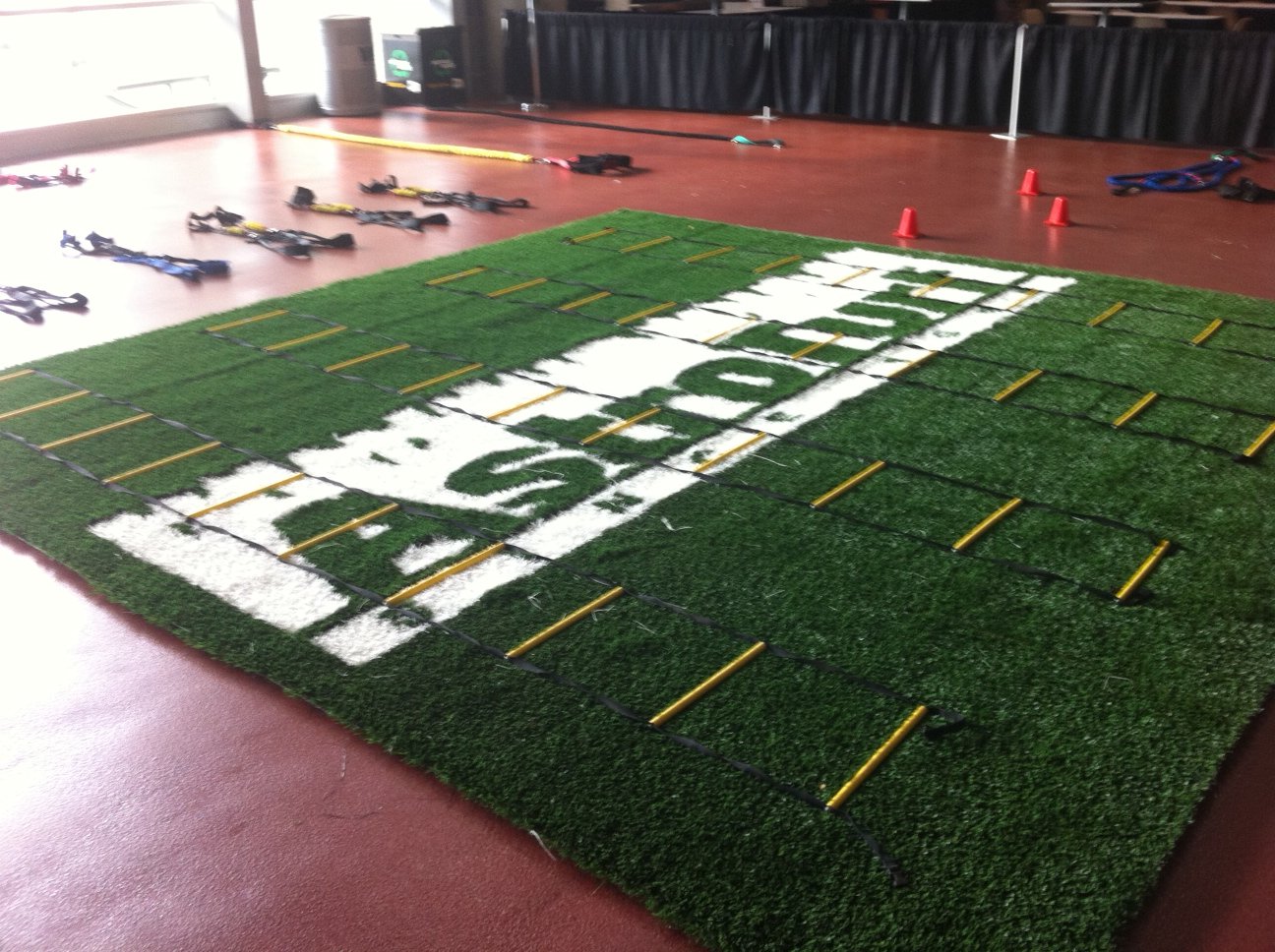
Competitive Edge Sports (CES) in Atlanta trains more prospective and current NFL players than any other private facility in the country. A lot of the training takes place on an indoor AstroTurf® field.
The company is getting ready to open a facility in Houston and they are trying to make a big splash this summer.
They have already been doing physicals at Reliant Stadium and will be hosting 7-on-7 passing camps and performance camps this summer. To promote their new facility, they are showcasing some of the things they do on AstroTurf®. The best part is they are doing it on a piece of turf with our logo.
Here is a photo that was taken this past weekend of the floor setup at a Reliant Stadium event.
CARL SMITH STADIUM AT UVA-WISE GETTING NEW ASTROTURF FIELD
(WISE, Virginia) - Despite the rain and unseasonably cool temperatures just a couple of days ago, it would be just about impossible to wipe the smile from Danny Sterling’s face.
Sterling, the athletic director at the University of Virginia’s College at Wise, is happy because the process is underway to install an all new AstroTurf® field at Carl Smith Stadium.
The Highland Cavaliers have played their last 12 seasons on an AstroTurf® System 12 field, and while the field was still in great shape, the school wanted to bring a new championship-caliber surface to the
stadium. The new field will be AstroTurf® GameDay™ Grass 3D52H.
“To say that excitement is the word would be an understatement,” said Sterling. “We can’t wait for the new field. The quality of this product won us over. We looked at other AstroTurf® installations at places like Old Dominion and Wake Forest and there was no question. We also have a long history and relationship with AstroTurf®, so that made the decision an easy one.”
The field will feature the revolutionary new Horseshoe™ fiber. This new fiber is enjoying unprecedented success in the sports field marketplace, due to factors such as its unique shape. The fiber is an “Omega” shape with two end columns with a thicker diameter. The design imparts mechanical memory so that the fiber remains upright longer, unlike other fields whose fibers quickly flatten and split or shred at the spine. The Horseshoe™ fiber continues to spring back to its original configuration, even after years of heavy foot traffic or exposure to ultra-violet radiation.
The field also has a face weight of 52 ounces of fiber per square yard. This adds to the durability provided by the fiber shape. Further enhancing the durability and safety of the field is the proprietary RootZone®, a dense sub-layer of texturized fibers which act as an infill stabilizer system to prevent migration and splash of the rubber granule infill.
In extensive testing, the Horseshoe® fiber performs most like natural grass from ball roll and slide resistance, to the biomechanical function of cleats penetrating and releasing properly. A study at Michigan State University, funded by NFL Charities, found that AstroTurf® GameDay Grass™ systems looked and performed more like natural grass than any other synthetic product measured, also making it the safest option.
The Horseshoe® fiber’s shape also allows it to reflect light and heat away from the surface. That, in combination with AstroFlect™ heat reduction technology, can lower surface temperatures by as much as 18%.
The Horseshoe™ fiber was introduced in 2010 and is already in use on practice fields at schools such as Stanford and the University of Tennessee; baseball game fields for the Tampa Bay Rays, Wake Forest, Duke; and numerous high school football fields around the country.
“We are excited about the partnership with UVA-Wise,” said Bryan Peeples, President of AstroTurf®. “Installing a championship-caliber field is a testimony to the commitment to the program. It’s also a game-changer when it comes to the pride young athletes, and the community at-large, take in the school.”
According to Sterling, the field will have a huge impact on the current student-athletes at the school, as well as influencing the decisions of potential Highland Cavaliers in the future.
The field at UVA-Wise will also allow the school to host, not only football games, but provide help in weather-related practice situations for the baseball and softball teams, and special events such as intramural championship games and other campus events.
Additionally, the field will play a large role in the community and will host little league games, as well as high school games, band camps, and summer camps.
Another impact the field will have is to make the Highland Cavaliers the envy of the Mid-South Conference, where the football team competes in the NAIA.
One Mid-South Conference school, Shorter University, started playing its home games last season on a new AstroTurf® field at Barron Stadium in Rome, Georgia. That stadium also happens to be the host stadium for the NAIA National Championship game. So, while the Highland Cavaliers are looking forward to playing their home games this year on their own AstroTurf®, it’s probably a safe bet to say they would like to be in a position to play on the AstroTurf® in Rome, Georgia in December.
The team will get its chance for a march on Georgia when they kick off the 2011 season at home on their new AstroTurf® on September 3rd against Webber International.
About AstroTurf®
For many athletes and sport enthusiasts, the AstroTurf® brand has redefined the way the game is played. AstroTurf® offers advanced, state-of-the-art, multi-sport, and specialized synthetic turf systems with proprietary engineered technologies, leveraging a vertically integrated manufacturing system. A growing number of high schools, colleges, professional sports teams and municipalities select AstroTurf®-branded products for their premium quality, technical superiority, and safety. To learn more, visit www.astroturfusa.com. You can also check out AstroTurf® on Facebook at http://www.facebook.com/#!/pages/AstroTurf/124352067595110.
Sterling, the athletic director at the University of Virginia’s College at Wise, is happy because the process is underway to install an all new AstroTurf® field at Carl Smith Stadium.
The Highland Cavaliers have played their last 12 seasons on an AstroTurf® System 12 field, and while the field was still in great shape, the school wanted to bring a new championship-caliber surface to the
stadium. The new field will be AstroTurf® GameDay™ Grass 3D52H.
“To say that excitement is the word would be an understatement,” said Sterling. “We can’t wait for the new field. The quality of this product won us over. We looked at other AstroTurf® installations at places like Old Dominion and Wake Forest and there was no question. We also have a long history and relationship with AstroTurf®, so that made the decision an easy one.”
The field will feature the revolutionary new Horseshoe™ fiber. This new fiber is enjoying unprecedented success in the sports field marketplace, due to factors such as its unique shape. The fiber is an “Omega” shape with two end columns with a thicker diameter. The design imparts mechanical memory so that the fiber remains upright longer, unlike other fields whose fibers quickly flatten and split or shred at the spine. The Horseshoe™ fiber continues to spring back to its original configuration, even after years of heavy foot traffic or exposure to ultra-violet radiation.
The field also has a face weight of 52 ounces of fiber per square yard. This adds to the durability provided by the fiber shape. Further enhancing the durability and safety of the field is the proprietary RootZone®, a dense sub-layer of texturized fibers which act as an infill stabilizer system to prevent migration and splash of the rubber granule infill.
In extensive testing, the Horseshoe® fiber performs most like natural grass from ball roll and slide resistance, to the biomechanical function of cleats penetrating and releasing properly. A study at Michigan State University, funded by NFL Charities, found that AstroTurf® GameDay Grass™ systems looked and performed more like natural grass than any other synthetic product measured, also making it the safest option.
The Horseshoe® fiber’s shape also allows it to reflect light and heat away from the surface. That, in combination with AstroFlect™ heat reduction technology, can lower surface temperatures by as much as 18%.
The Horseshoe™ fiber was introduced in 2010 and is already in use on practice fields at schools such as Stanford and the University of Tennessee; baseball game fields for the Tampa Bay Rays, Wake Forest, Duke; and numerous high school football fields around the country.
“We are excited about the partnership with UVA-Wise,” said Bryan Peeples, President of AstroTurf®. “Installing a championship-caliber field is a testimony to the commitment to the program. It’s also a game-changer when it comes to the pride young athletes, and the community at-large, take in the school.”
According to Sterling, the field will have a huge impact on the current student-athletes at the school, as well as influencing the decisions of potential Highland Cavaliers in the future.
The field at UVA-Wise will also allow the school to host, not only football games, but provide help in weather-related practice situations for the baseball and softball teams, and special events such as intramural championship games and other campus events.
Additionally, the field will play a large role in the community and will host little league games, as well as high school games, band camps, and summer camps.
Another impact the field will have is to make the Highland Cavaliers the envy of the Mid-South Conference, where the football team competes in the NAIA.
One Mid-South Conference school, Shorter University, started playing its home games last season on a new AstroTurf® field at Barron Stadium in Rome, Georgia. That stadium also happens to be the host stadium for the NAIA National Championship game. So, while the Highland Cavaliers are looking forward to playing their home games this year on their own AstroTurf®, it’s probably a safe bet to say they would like to be in a position to play on the AstroTurf® in Rome, Georgia in December.
The team will get its chance for a march on Georgia when they kick off the 2011 season at home on their new AstroTurf® on September 3rd against Webber International.
About AstroTurf®
For many athletes and sport enthusiasts, the AstroTurf® brand has redefined the way the game is played. AstroTurf® offers advanced, state-of-the-art, multi-sport, and specialized synthetic turf systems with proprietary engineered technologies, leveraging a vertically integrated manufacturing system. A growing number of high schools, colleges, professional sports teams and municipalities select AstroTurf®-branded products for their premium quality, technical superiority, and safety. To learn more, visit www.astroturfusa.com. You can also check out AstroTurf® on Facebook at http://www.facebook.com/#!/pages/AstroTurf/124352067595110.
Wednesday, May 18, 2011
TEXAS A&M DEPARTMENT OF RECREATIONAL SPORTS ADDS ASTROTURF® FIELDS
(COLLEGE STATION, Texas) - Texas A&M University has enlisted the help of AstroTurf® to create more playing opportunities for the approximately 15,000 students who participate in intramural sports and sport clubs at the College Station school.
The Penberthy Rec Sports Complex is a 48-acre facility which plays host to the outdoor intramural and sport clubs programs for Aggie students. The complex was named for W.L. Penberthy, the father of intramural sports at Texas A&M.
Over 463,500 square feet of that facility is being converted to AstroTurf®. Construction is underway and all fields are scheduled for completion by August.
“We knew we needed to make a change to synthetic turf,” said Rick Hall, Senior Associate Director of Rec Sports. “We talked with several turf companies and educated ourselves throughout the process. AstroTurf® is the one that impressed us. We feel like we’re getting the best turf system at a very affordable price.”
Hall, along with other representatives from Texas A&M, visited Brenham High School’s Cub Stadium field and the eight AstroTurf® fields at West Texas A&M University during the process, and came away knowing that AstroTurf® was the right decision.
The fields will be constructed of AstroTurf® GameDay Grass™ Extreme. The new surface contains the all new Horseshoe™ fiber. Horseshoe™, is an Omega-shaped fiber which has better mechanical memory and remains upright longer, has a more grass-like ball roll, and offers the best aesthetics of any field. It is combined with the AstroTurf® XP fiber. XP is a slit-film product which offers better infill encapsulation, best resistance to wear, and great pile density. The product also features texturized RootZone®. RootZone® is a fiber which acts as a thatch layer, creating minimal rubber splash, uniform energy return, and better shock absorbency, while encapsulating the infill and reducing migration.
Burnside Services is handling all base and drainage work on the project, as well as all driveways and parking lots. Burnside is operated by Tommy, Dayle, and Jake Burnside, all of whom attended Texas A&M.
“This is, by far, the largest athletic field project we have worked on,” said Tommy Burnside. “This is about 11 acres of turf and we will be moving 50,000 yards of dirt.”
Two of the fields will be 150 yards X 100 yards and will primarily host intramural sports events such as flag football and soccer. Each field can accommodate two flag football fields or modified soccer fields. Each field will also be able to be converted to full-size fields for soccer, lacrosse, and ultimate.
“We have one of the largest intramural sports and sport clubs programs in the country,” said Hall. “Athletes use those fields from 6:00 p.m. until midnight, five days a week and we were wearing out our fields by the sheer volume of play.”
The weather didn’t help either. According to Hall, from September to the end of January in 2008, they had 7 inches of rain and 20 lost rain days. In the same period, from September 2009 until January 2010, they had nearly 20 inches of rain with 44 lost rain days. They needed an alternative.
“With AstroTurf® we are getting surfaces which are not affected by the weather,” said Hall. “Also, it allows us to implement some field rotation to help keep our natural grass fields in great shape. Rotation was a luxury we didn’t have before.”
Intramural sports, first brought to college campuses in 1913, continue to grow in both popularity and importance. According to the National Intramural-Recreational Sports Association (NIRSA), 75% of students who attend school offering recreational sports programs and facilities, participate in or use them. That numbers equals approximately 5.3 million students.
A 2006 study published in Recreational Sports Journal said 31% of students reported that an intramural sports program was an important factor in attending the college, and over 37% said those same programs were important in deciding to stay at the school. 83% of students said they participate in recreation sports on a weekly basis, and 93% said they would like to.
“We have a lot of prospective students and parents who look at our indoor and outdoor rec sports facilities,” said Hall. “I have no doubt it influences their decisions. It is a key factor in the development of life skills and wellness. It also has some effect on the recruiting of faculty and staff members.”
The other two fields will be 150 yards X 85 yards and will host the university’s sport club programs such as lacrosse, soccer, ultimate, and rugby.
Sport clubs are also an important part of the collegiate recreational landscape. Over 80 sports are offered for sport clubs at colleges across the country and nearly 11,000 sport clubs are registered and active at NIRSA member institutions.
While the Texas A&M project is a large one by most standards, it is just part of a growing trend toward recreational sports development. In 2008, NIRSA estimated nearly $4 billion in recreational sports facility construction between 2008-2013. Those project estimates were for 96 new construction projects, 62 expansion projects, and 62 renovation projects, with an average project price of about $21 million and covering about 90,000 square feet.
The growth in projects such as this will make Texas A&M a showcase facility for others looking at similar projects. Hall said they will be hosting regional workshops for other schools later in the year and anticipates spending a lot of time showing the new AstroTurf® fields and touting the positive benefits of having them. He is also expecting calls from other high schools and municipalities which are exploring the benefits of synthetic turf.
The fields at Penberthy will also have an added environmental and economic impact. In 2010, BASF did a study comparing AstroTurf® fields to natural grass fields. In 11 environmental categories, AstroTurf® had a lower environmental footprint than natural grass. Factors contributing to this include reduced maintenance and mowing, which cause a variety of emissions. Other factors include elimination of fertilizers and pesticides, as well as the need for water. AstroTurf® fields also use soy-based polyols in the backing of products, reducing their dependence on foreign oil.
From an economic standpoint, over 20 years, AstroTurf® fields are 15% less expensive than natural grass fields, even when the cost of turf replacement is considered.
“We are proud to be a part of this enormous project at Texas A&M University,” said Bryan Peeples, President of AstroTurf®. “Recreational and club sports are so important and these fields will allow Texas A&M to provide the very best surfaces available, while ensuring the growth of their programs over the years to come.”
About AstroTurf®
For many athletes and sport enthusiasts, the AstroTurf® brand has redefined the way the game is played. The company offers advanced, state-of-the-art, multi-sport and specialized synthetic turf systems with proprietary engineered technologies, leveraging the industry’s first vertically integrated manufacturing system. A growing number of high schools, colleges, professional sports teams and municipalities continue to select AstroTurf®-branded products for their premium quality, technical superiority and safety. Recent innovations from AstroTurf® include GameDay Grass™ 3D with RootZone®, a polyethylene/nylon hybrid system which most closely replicates natural grass; a non-chemical antimicrobial shield protecting against MRSA and other infectious bacteria; and AstroFlect™ Technology which significantly reduces turf surface temperatures. To learn more, visit www.astroturfusa.com.
The Penberthy Rec Sports Complex is a 48-acre facility which plays host to the outdoor intramural and sport clubs programs for Aggie students. The complex was named for W.L. Penberthy, the father of intramural sports at Texas A&M.
Over 463,500 square feet of that facility is being converted to AstroTurf®. Construction is underway and all fields are scheduled for completion by August.
“We knew we needed to make a change to synthetic turf,” said Rick Hall, Senior Associate Director of Rec Sports. “We talked with several turf companies and educated ourselves throughout the process. AstroTurf® is the one that impressed us. We feel like we’re getting the best turf system at a very affordable price.”
Hall, along with other representatives from Texas A&M, visited Brenham High School’s Cub Stadium field and the eight AstroTurf® fields at West Texas A&M University during the process, and came away knowing that AstroTurf® was the right decision.
The fields will be constructed of AstroTurf® GameDay Grass™ Extreme. The new surface contains the all new Horseshoe™ fiber. Horseshoe™, is an Omega-shaped fiber which has better mechanical memory and remains upright longer, has a more grass-like ball roll, and offers the best aesthetics of any field. It is combined with the AstroTurf® XP fiber. XP is a slit-film product which offers better infill encapsulation, best resistance to wear, and great pile density. The product also features texturized RootZone®. RootZone® is a fiber which acts as a thatch layer, creating minimal rubber splash, uniform energy return, and better shock absorbency, while encapsulating the infill and reducing migration.
Burnside Services is handling all base and drainage work on the project, as well as all driveways and parking lots. Burnside is operated by Tommy, Dayle, and Jake Burnside, all of whom attended Texas A&M.
“This is, by far, the largest athletic field project we have worked on,” said Tommy Burnside. “This is about 11 acres of turf and we will be moving 50,000 yards of dirt.”
Two of the fields will be 150 yards X 100 yards and will primarily host intramural sports events such as flag football and soccer. Each field can accommodate two flag football fields or modified soccer fields. Each field will also be able to be converted to full-size fields for soccer, lacrosse, and ultimate.
“We have one of the largest intramural sports and sport clubs programs in the country,” said Hall. “Athletes use those fields from 6:00 p.m. until midnight, five days a week and we were wearing out our fields by the sheer volume of play.”
The weather didn’t help either. According to Hall, from September to the end of January in 2008, they had 7 inches of rain and 20 lost rain days. In the same period, from September 2009 until January 2010, they had nearly 20 inches of rain with 44 lost rain days. They needed an alternative.
“With AstroTurf® we are getting surfaces which are not affected by the weather,” said Hall. “Also, it allows us to implement some field rotation to help keep our natural grass fields in great shape. Rotation was a luxury we didn’t have before.”
Intramural sports, first brought to college campuses in 1913, continue to grow in both popularity and importance. According to the National Intramural-Recreational Sports Association (NIRSA), 75% of students who attend school offering recreational sports programs and facilities, participate in or use them. That numbers equals approximately 5.3 million students.
A 2006 study published in Recreational Sports Journal said 31% of students reported that an intramural sports program was an important factor in attending the college, and over 37% said those same programs were important in deciding to stay at the school. 83% of students said they participate in recreation sports on a weekly basis, and 93% said they would like to.
“We have a lot of prospective students and parents who look at our indoor and outdoor rec sports facilities,” said Hall. “I have no doubt it influences their decisions. It is a key factor in the development of life skills and wellness. It also has some effect on the recruiting of faculty and staff members.”
The other two fields will be 150 yards X 85 yards and will host the university’s sport club programs such as lacrosse, soccer, ultimate, and rugby.
Sport clubs are also an important part of the collegiate recreational landscape. Over 80 sports are offered for sport clubs at colleges across the country and nearly 11,000 sport clubs are registered and active at NIRSA member institutions.
While the Texas A&M project is a large one by most standards, it is just part of a growing trend toward recreational sports development. In 2008, NIRSA estimated nearly $4 billion in recreational sports facility construction between 2008-2013. Those project estimates were for 96 new construction projects, 62 expansion projects, and 62 renovation projects, with an average project price of about $21 million and covering about 90,000 square feet.
The growth in projects such as this will make Texas A&M a showcase facility for others looking at similar projects. Hall said they will be hosting regional workshops for other schools later in the year and anticipates spending a lot of time showing the new AstroTurf® fields and touting the positive benefits of having them. He is also expecting calls from other high schools and municipalities which are exploring the benefits of synthetic turf.
The fields at Penberthy will also have an added environmental and economic impact. In 2010, BASF did a study comparing AstroTurf® fields to natural grass fields. In 11 environmental categories, AstroTurf® had a lower environmental footprint than natural grass. Factors contributing to this include reduced maintenance and mowing, which cause a variety of emissions. Other factors include elimination of fertilizers and pesticides, as well as the need for water. AstroTurf® fields also use soy-based polyols in the backing of products, reducing their dependence on foreign oil.
From an economic standpoint, over 20 years, AstroTurf® fields are 15% less expensive than natural grass fields, even when the cost of turf replacement is considered.
“We are proud to be a part of this enormous project at Texas A&M University,” said Bryan Peeples, President of AstroTurf®. “Recreational and club sports are so important and these fields will allow Texas A&M to provide the very best surfaces available, while ensuring the growth of their programs over the years to come.”
About AstroTurf®
For many athletes and sport enthusiasts, the AstroTurf® brand has redefined the way the game is played. The company offers advanced, state-of-the-art, multi-sport and specialized synthetic turf systems with proprietary engineered technologies, leveraging the industry’s first vertically integrated manufacturing system. A growing number of high schools, colleges, professional sports teams and municipalities continue to select AstroTurf®-branded products for their premium quality, technical superiority and safety. Recent innovations from AstroTurf® include GameDay Grass™ 3D with RootZone®, a polyethylene/nylon hybrid system which most closely replicates natural grass; a non-chemical antimicrobial shield protecting against MRSA and other infectious bacteria; and AstroFlect™ Technology which significantly reduces turf surface temperatures. To learn more, visit www.astroturfusa.com.
MEMORIAL STADIUM IN DALHART, TEXAS GETS NEW ASTROTURF FIELD
(DALHART, Texas) - Dalhart High School and Dalhart Junior High School will soon be playing their home games in a completely revamped Memorial Stadium.
Part of the process includes the installation of a new AstroTurf® field, which is now underway. The overall project, which is being funded by a nearly $5 million Qualified School Construction Bond, with no tax rate increase, will cover a variety of projects.
The project will completely renovate Memorial Stadium, adding an eight-lane track and AstroTurf® field, as well as a new field house, concession stand, and public restrooms. It will also provide playground space and equipment at Dalhart Intermediate School, repair of damage to the intermediate and elementary schools, and completion of the Spirit Trail.
“We are thrilled about the new field,” said Dalhart ISD Superintendent David Foote. “This is the best thing for our kids. Our students are excited and the people in the community are excited. We’ve needed this for a long time.”
According to Athletic Director and Head Football Coach Stephen Young, much of the decision to go to synthetic turf was based on three major factors.
“First, we faced costs such as water, fertilizer, pesticides, and mowing, said Young. “Second, we deal with a large number of weather-related issues. We could have 12 inches of snow or be facing a drought. Finally, the overall facility was in disrepair. It has been around since 1943 and it is just time.”
Foote, Young, and others looked at turf surfaces offered by a variety of companies. The Golden Wolves play on a couple of synthetic turf surfaces during the year, but the AstroTurf® field at Muleshoe High School helped seal the deal.
The new field, like the one at Muleshoe, will feature AstroTurf® GameDay Grass™ 3D60H. This surface features the all new Horseshoe fiber. This new fiber is enjoying unprecedented success in the sports field marketplace, due to factors such as its unique shape. The fiber is an “Omega” shape with two end columns with a thicker diameter. The design imparts mechanical memory so that the fiber remains upright longer, unlike other fields whose fibers quickly flatten and split or shred at the spine. The Horseshoe™ fiber continues to spring back to its original configuration, even after years of heavy foot traffic or exposure to ultra-violet radiation.
The field also has a face weight of 60 ounces of fiber per square yard, the highest in the industry. This adds to the durability provided by the fiber shape.
In extensive testing, the Horseshoe® fiber performs most like natural grass from ball roll, to slide
resistance, to the biomechanical function of cleats penetrating and releasing properly. A study at Michigan State University, funded by NFL Charities, found that AstroTurf® GameDay Grass™ systems looked and performed more like natural grass than any other synthetic product measured, also making it the safest option.
The Horseshoe® fiber’s shape also allows it to reflect light and heat away from the surface. That, in combination with AstroFlect™ heat reduction technology, can lower surface temperatures by as much as 18%.
The Horseshoe™ fiber was introduced in 2010 and is already in use on practice fields at schools such as Stanford and the University of Tennessee; baseball game fields for the Tampa Bay Rays, Wake Forest, Duke; and numerous high school football fields around the country.
“This is a playing surface that is second-to-none,” said AstroTurf® President Bryan Peeples. “We are extremely proud of this surface and we know that students and people of Dalhart will be, too. There is nothing like the pride and spirit that comes with having a playing field like the one Dalhart is building.”
The field at Dalhart will also have an added environmental and economic impact. In 2010, BASF did a study comparing AstroTurf® fields to natural grass fields. In 11 environmental categories, AstroTurf® had a lower environmental footprint than natural grass. Factors contributing to this include reduced maintenance and mowing, which cause a variety of emissions. Other factors include elimination of fertilizers and pesticides, as well as the need for water. AstroTurf® fields also use soy-based polyols in the backing of products, reducing their dependence on foreign oil.
From an economic standpoint, over 20 years, AstroTurf® fields are 15% less expensive than natural grass fields, even when the cost of turf replacement is considered.
“We can’t wait to play on this field,” said Young. “We had a good team last year and I wish they could have played on it. But, I’ve told our kids who are coming back that the baton has been passed and this is their opportunity to perform and to perform on a championship-caliber field.”
The Golden Wolves will get that opportunity at home on September 9th, against Brownfield.
About AstroTurf®
For many athletes and sport enthusiasts, the AstroTurf® brand has redefined the way the game is played. The company offers advanced, state-of-the-art, multi-sport and specialized synthetic turf systems with proprietary engineered technologies, leveraging the industry’s first vertically integrated manufacturing system. A growing number of high schools, colleges, professional sports teams and municipalities continue to select AstroTurf®-branded products for their premium quality, technical superiority and safety. Recent innovations from AstroTurf® include GameDay Grass™ 3D with RootZone®, a polyethylene/nylon hybrid system which most closely replicates natural grass; a non-chemical antimicrobial shield protecting against MRSA and other infectious bacteria; and AstroFlect™ Technology which significantly reduces turf surface temperatures. To learn more, visit www.astroturfusa.com.
Part of the process includes the installation of a new AstroTurf® field, which is now underway. The overall project, which is being funded by a nearly $5 million Qualified School Construction Bond, with no tax rate increase, will cover a variety of projects.
The project will completely renovate Memorial Stadium, adding an eight-lane track and AstroTurf® field, as well as a new field house, concession stand, and public restrooms. It will also provide playground space and equipment at Dalhart Intermediate School, repair of damage to the intermediate and elementary schools, and completion of the Spirit Trail.
“We are thrilled about the new field,” said Dalhart ISD Superintendent David Foote. “This is the best thing for our kids. Our students are excited and the people in the community are excited. We’ve needed this for a long time.”
According to Athletic Director and Head Football Coach Stephen Young, much of the decision to go to synthetic turf was based on three major factors.
“First, we faced costs such as water, fertilizer, pesticides, and mowing, said Young. “Second, we deal with a large number of weather-related issues. We could have 12 inches of snow or be facing a drought. Finally, the overall facility was in disrepair. It has been around since 1943 and it is just time.”
Foote, Young, and others looked at turf surfaces offered by a variety of companies. The Golden Wolves play on a couple of synthetic turf surfaces during the year, but the AstroTurf® field at Muleshoe High School helped seal the deal.
The new field, like the one at Muleshoe, will feature AstroTurf® GameDay Grass™ 3D60H. This surface features the all new Horseshoe fiber. This new fiber is enjoying unprecedented success in the sports field marketplace, due to factors such as its unique shape. The fiber is an “Omega” shape with two end columns with a thicker diameter. The design imparts mechanical memory so that the fiber remains upright longer, unlike other fields whose fibers quickly flatten and split or shred at the spine. The Horseshoe™ fiber continues to spring back to its original configuration, even after years of heavy foot traffic or exposure to ultra-violet radiation.
The field also has a face weight of 60 ounces of fiber per square yard, the highest in the industry. This adds to the durability provided by the fiber shape.
In extensive testing, the Horseshoe® fiber performs most like natural grass from ball roll, to slide
resistance, to the biomechanical function of cleats penetrating and releasing properly. A study at Michigan State University, funded by NFL Charities, found that AstroTurf® GameDay Grass™ systems looked and performed more like natural grass than any other synthetic product measured, also making it the safest option.
The Horseshoe® fiber’s shape also allows it to reflect light and heat away from the surface. That, in combination with AstroFlect™ heat reduction technology, can lower surface temperatures by as much as 18%.
The Horseshoe™ fiber was introduced in 2010 and is already in use on practice fields at schools such as Stanford and the University of Tennessee; baseball game fields for the Tampa Bay Rays, Wake Forest, Duke; and numerous high school football fields around the country.
“This is a playing surface that is second-to-none,” said AstroTurf® President Bryan Peeples. “We are extremely proud of this surface and we know that students and people of Dalhart will be, too. There is nothing like the pride and spirit that comes with having a playing field like the one Dalhart is building.”
The field at Dalhart will also have an added environmental and economic impact. In 2010, BASF did a study comparing AstroTurf® fields to natural grass fields. In 11 environmental categories, AstroTurf® had a lower environmental footprint than natural grass. Factors contributing to this include reduced maintenance and mowing, which cause a variety of emissions. Other factors include elimination of fertilizers and pesticides, as well as the need for water. AstroTurf® fields also use soy-based polyols in the backing of products, reducing their dependence on foreign oil.
From an economic standpoint, over 20 years, AstroTurf® fields are 15% less expensive than natural grass fields, even when the cost of turf replacement is considered.
“We can’t wait to play on this field,” said Young. “We had a good team last year and I wish they could have played on it. But, I’ve told our kids who are coming back that the baton has been passed and this is their opportunity to perform and to perform on a championship-caliber field.”
The Golden Wolves will get that opportunity at home on September 9th, against Brownfield.
About AstroTurf®
For many athletes and sport enthusiasts, the AstroTurf® brand has redefined the way the game is played. The company offers advanced, state-of-the-art, multi-sport and specialized synthetic turf systems with proprietary engineered technologies, leveraging the industry’s first vertically integrated manufacturing system. A growing number of high schools, colleges, professional sports teams and municipalities continue to select AstroTurf®-branded products for their premium quality, technical superiority and safety. Recent innovations from AstroTurf® include GameDay Grass™ 3D with RootZone®, a polyethylene/nylon hybrid system which most closely replicates natural grass; a non-chemical antimicrobial shield protecting against MRSA and other infectious bacteria; and AstroFlect™ Technology which significantly reduces turf surface temperatures. To learn more, visit www.astroturfusa.com.
Thursday, May 12, 2011
WILLIAM SMITH COLLEGE GETTING NEW ASTORTURF FIELD HOCKEY SURFACE
(GENEVA, New York) - For the William Smith Herons field hockey team, it’s AstroTurf®……again.
The highly successful NCAA Division III program has announced the selection of an AstroTurf® 12 system to replace the current AstroTurf® system at H.J. McCooey Memorial Field.
The team, coached by longtime veteran Sally Scatton has made an undeniable impact on collegiate field hockey. In her 22 years at the helm, the Herons have won NCAA Division III titles in 1992, 1997, and 2000, with 20 post-season appearances. Under Scatton, the Herons have never had a losing season. The team has also won the Liberty League title 9 times since it was formed in 1995.
Scatton has chaired the NCAA Division III Field Hockey Committee and was selected as the National Field Hockey Coaches Association (NFHCA) Regional and National Coach of the Year three times. Scatton is a graduate of Ithaca College, where she played field hockey and lacrosse for four years, and basketball for three years. In 1997, she was inducted into the Ithaca College Sports Hall of Fame. In 2007, she was inducted into the William Smith Heron Hall of Honor, and on January 9, 2010, Scatton was inducted into the NFHCA Hall of Fame.
The successful pedigree of Scatton and her team are also reflected in the stadium where they play. H.J. McCooey Memorial Field seats 1,500 and features an AstroTurf® 12 field which was installed in 2000. The field has hosted three NCAA Championships; the 2002 NCAA Division III Women’s Soccer Championship, the 2006 NCAA Division III Field Hockey Championship, and the 2007 NCAA Women’s Lacrosse Championship.
“When it came time to replace our current AstroTurf® surface, it quickly became clear that a new AstroTurf® system was the right choice for William Smith,” said Coach Scatton. “For the past 10 years, our team has practiced and competed on AstroTurf® and I love the quality and durability of the product. The approval by our president and Board of Trustees to install AstroTurf® 12 reinforced our commitment to providing the best possible playing experience for our student-athletes. This project will allow us to continue to have one of the finest collegiate field hockey facilities in the nation.”
The new surface will also be an AstroTurf® 12 system. The field will be engineered with a proven, premium knitted nylon fiber designed to provide uniform traction and consistent footing. It will improve playability when it’s wet and absorbs water to maintain wet conditions longer.
Construction is under way and will be completed by early July.
“William Smith has truly made a mark in collegiate field hockey,” said Pam Hixon, hall of fame field hockey coach and Field Hockey Ambassador with AstroTurf®. “Coach Scatton, the athletes, and the support of the college have made this program so successful. That success is also in no small part due to the AstroTurf® field they play on. It’s the finest surface in the world. Having a brand new AstroTurf® surface for next season will, no doubt, make the program even more successful.”
AstroTurf® 12 systems were first used in an international field hockey event in 1975 in Montreal. The same field hosted the Olympics in 1976. Since then, they have become the preferred surface for field hockey events around the globe.
AstroTurf® surfaces were also used in the 1996 Olympics in Atlanta and 2008 Olympics in Beijing. The AstroTurf® 12 system has also seen play in the Pan Am games, World Cup and numerous other field hockey events. The U.S. National team trains on AstroTurf® in Chula Vista, California, and Virginia Beach, Virginia.
Also, a new AstroTurf® 12 system is used by the University of Maryland, 2011 NCAA Division I Champions. To date, all NCAA Division I National Championships have been played on AstroTurf® fields. The 2011 event will be held at the University of Louisville, on a new AstroTurf® 12 surface just like the ones the Herons will be playing on.
The Herons will open their season on the new AstroTurf® field on September 1, 2011, when they face Oswego State.
About AstroTurf®
For many athletes and sport enthusiasts, the AstroTurf® brand has redefined the way the game is played. The company offers advanced, state-of-the-art, multi-sport and specialized synthetic turf systems with proprietary engineered technologies, leveraging the industry’s only vertically integrated manufacturing system. A growing number of high schools, colleges, professional sports teams and municipalities continue to select AstroTurf®-branded products for their premium quality, technical superiority and safety. Recent innovations from AstroTurf® include GameDay Grass™ 3D with RootZone®, a polyethylene/nylon hybrid system which most closely replicates natural grass; TurfAide™, a non-chemical antimicrobial shield protecting against MRSA and other infectious bacteria; and AstroFlect™ Technology which significantly reduces turf surface temperatures. To learn more, visit www.astroturfusa.com.
The highly successful NCAA Division III program has announced the selection of an AstroTurf® 12 system to replace the current AstroTurf® system at H.J. McCooey Memorial Field.
The team, coached by longtime veteran Sally Scatton has made an undeniable impact on collegiate field hockey. In her 22 years at the helm, the Herons have won NCAA Division III titles in 1992, 1997, and 2000, with 20 post-season appearances. Under Scatton, the Herons have never had a losing season. The team has also won the Liberty League title 9 times since it was formed in 1995.
Scatton has chaired the NCAA Division III Field Hockey Committee and was selected as the National Field Hockey Coaches Association (NFHCA) Regional and National Coach of the Year three times. Scatton is a graduate of Ithaca College, where she played field hockey and lacrosse for four years, and basketball for three years. In 1997, she was inducted into the Ithaca College Sports Hall of Fame. In 2007, she was inducted into the William Smith Heron Hall of Honor, and on January 9, 2010, Scatton was inducted into the NFHCA Hall of Fame.
The successful pedigree of Scatton and her team are also reflected in the stadium where they play. H.J. McCooey Memorial Field seats 1,500 and features an AstroTurf® 12 field which was installed in 2000. The field has hosted three NCAA Championships; the 2002 NCAA Division III Women’s Soccer Championship, the 2006 NCAA Division III Field Hockey Championship, and the 2007 NCAA Women’s Lacrosse Championship.
“When it came time to replace our current AstroTurf® surface, it quickly became clear that a new AstroTurf® system was the right choice for William Smith,” said Coach Scatton. “For the past 10 years, our team has practiced and competed on AstroTurf® and I love the quality and durability of the product. The approval by our president and Board of Trustees to install AstroTurf® 12 reinforced our commitment to providing the best possible playing experience for our student-athletes. This project will allow us to continue to have one of the finest collegiate field hockey facilities in the nation.”
The new surface will also be an AstroTurf® 12 system. The field will be engineered with a proven, premium knitted nylon fiber designed to provide uniform traction and consistent footing. It will improve playability when it’s wet and absorbs water to maintain wet conditions longer.
Construction is under way and will be completed by early July.
“William Smith has truly made a mark in collegiate field hockey,” said Pam Hixon, hall of fame field hockey coach and Field Hockey Ambassador with AstroTurf®. “Coach Scatton, the athletes, and the support of the college have made this program so successful. That success is also in no small part due to the AstroTurf® field they play on. It’s the finest surface in the world. Having a brand new AstroTurf® surface for next season will, no doubt, make the program even more successful.”
AstroTurf® 12 systems were first used in an international field hockey event in 1975 in Montreal. The same field hosted the Olympics in 1976. Since then, they have become the preferred surface for field hockey events around the globe.
AstroTurf® surfaces were also used in the 1996 Olympics in Atlanta and 2008 Olympics in Beijing. The AstroTurf® 12 system has also seen play in the Pan Am games, World Cup and numerous other field hockey events. The U.S. National team trains on AstroTurf® in Chula Vista, California, and Virginia Beach, Virginia.
Also, a new AstroTurf® 12 system is used by the University of Maryland, 2011 NCAA Division I Champions. To date, all NCAA Division I National Championships have been played on AstroTurf® fields. The 2011 event will be held at the University of Louisville, on a new AstroTurf® 12 surface just like the ones the Herons will be playing on.
The Herons will open their season on the new AstroTurf® field on September 1, 2011, when they face Oswego State.
About AstroTurf®
For many athletes and sport enthusiasts, the AstroTurf® brand has redefined the way the game is played. The company offers advanced, state-of-the-art, multi-sport and specialized synthetic turf systems with proprietary engineered technologies, leveraging the industry’s only vertically integrated manufacturing system. A growing number of high schools, colleges, professional sports teams and municipalities continue to select AstroTurf®-branded products for their premium quality, technical superiority and safety. Recent innovations from AstroTurf® include GameDay Grass™ 3D with RootZone®, a polyethylene/nylon hybrid system which most closely replicates natural grass; TurfAide™, a non-chemical antimicrobial shield protecting against MRSA and other infectious bacteria; and AstroFlect™ Technology which significantly reduces turf surface temperatures. To learn more, visit www.astroturfusa.com.
Friday, April 22, 2011
LOUISVILLE CARDINALS FIELD HOCKEY TEAM SELECTS ASTROTURF AT TRAGER STADIUM
(LOUISVILLE, Kentucky) - The University of Louisville is gaining a reputation as a world-class program under a new world-class coach. In 2011, the Cardinals will play on a new world-class AstroTurf® surface.
The Cardinals, under first-year head coach Justine Sowry, were 13-7 and ranked 14th in the nation in 2010.
The program will also get a boost this year when they host the NCAA Division I Field Hockey Championships for the fourth time since 2002 at Trager Stadium.
“As the new head coach, the installation of the new AstroTurf® is exciting for us,” said Justine Sowry, head coach of the Louisville field hockey team. “This is a new chapter for our program and a chance to establish our own culture, vision, and goals. Part of that comes from having the best facilities in the country and a tremendous step in that direction is having a world-class field.”
Sowry, a native of Australia, previously coached for four years at the University of Massachusetts, where she won three Atlantic 10 Championships and made three NCAA appearances. Sowry was at Louisville as an assistant coach from 1998-2002. She has also been an assistant at Stanford University and for the U.S. National Team.
As a player, Sowry was a member of the Australian National Team and made 128 international appearances. She represented Australia from 1993-2001, and won gold medals in the World Cup in 1994 and 1998.
In her experience as a player and coach, she has been all over the world. Sowry says she played predominantly on AstroTurf® and believes that is the only choice for a great field because it is proven and tested at all levels. She knows it will benefit her team in preparation and games, as well as how it will affect Louisville’s reputation.
“This new field and hosting the NCAA Championships will highlight our program in Division I field hockey circles,” said Sowry.
Sowry and the Cardinals’ program are truly on the move.
“Justine was a great player and is a great coach,” said Pam Hixon, a field hockey hall-of-famer, is a legendary coach and is currently the Field Hockey Ambassador for AstroTurf®. “With her coaching ability, the talent of the Louisville team, and having the finest AstroTurf ® field, means that the Louisville program is on its way to the top.”
Construction is underway on the new AstroTurf® field and will be completed by June 1st.
The field will be an AstroTurf® 12 synthetic turf system. The field will be engineered with a premium knitted nylon system designed to provide uniform traction and consistent footing. It will improve playability when it is wet and absorbs water to maintain wet conditions longer.
“We have a strong program with a very high-profile facility,” said Pete Cautilli, Associate Athletic Director at Louisville. “AstroTurf® 12 is recognized as the industry leader for field hockey playing surfaces. For us, that was the logical choice.”
Upon completion, the field will be utilized for camps and training. The first home game of the year will feature the Cardinals taking on California on August 26th. The 2011 schedule will find the Cardinals facing seven of the Top 20 teams in the country and six teams which participated in the 2010 NCAA Championships. Louisville will play nine home games at Trager Stadium.
The NCAA Championships will take place on the new AstroTurf® at Trager Stadium in November. The semifinals will be held November 18th and the finals will take place on November 20th.
The installation of the new AstroTurf® field is currently underway and you can watch it live at www.astroturfusa.com.
About AstroTurf®
For many athletes and sport enthusiasts, the AstroTurf® brand has redefined the way the game is played. The company offers advanced, state-of-the-art, multi-sport and specialized synthetic turf systems with proprietary engineered technologies, leveraging the industry’s only vertically integrated manufacturing system. A growing number of high schools, colleges, professional sports teams and municipalities continue to select AstroTurf®-branded products for their premium quality, technical superiority and safety. Recent innovations from AstroTurf® include GameDay Grass™ 3D with RootZone®, a polyethylene/nylon hybrid system which most closely replicates natural grass; TurfAide™, a non-chemical antimicrobial shield protecting against MRSA and other infectious bacteria; and AstroFlect™ Technology which significantly reduces turf surface temperatures. To learn more, visit www.astroturfusa.com.
The Cardinals, under first-year head coach Justine Sowry, were 13-7 and ranked 14th in the nation in 2010.
The program will also get a boost this year when they host the NCAA Division I Field Hockey Championships for the fourth time since 2002 at Trager Stadium.
“As the new head coach, the installation of the new AstroTurf® is exciting for us,” said Justine Sowry, head coach of the Louisville field hockey team. “This is a new chapter for our program and a chance to establish our own culture, vision, and goals. Part of that comes from having the best facilities in the country and a tremendous step in that direction is having a world-class field.”
Sowry, a native of Australia, previously coached for four years at the University of Massachusetts, where she won three Atlantic 10 Championships and made three NCAA appearances. Sowry was at Louisville as an assistant coach from 1998-2002. She has also been an assistant at Stanford University and for the U.S. National Team.
As a player, Sowry was a member of the Australian National Team and made 128 international appearances. She represented Australia from 1993-2001, and won gold medals in the World Cup in 1994 and 1998.
In her experience as a player and coach, she has been all over the world. Sowry says she played predominantly on AstroTurf® and believes that is the only choice for a great field because it is proven and tested at all levels. She knows it will benefit her team in preparation and games, as well as how it will affect Louisville’s reputation.
“This new field and hosting the NCAA Championships will highlight our program in Division I field hockey circles,” said Sowry.
Sowry and the Cardinals’ program are truly on the move.
“Justine was a great player and is a great coach,” said Pam Hixon, a field hockey hall-of-famer, is a legendary coach and is currently the Field Hockey Ambassador for AstroTurf®. “With her coaching ability, the talent of the Louisville team, and having the finest AstroTurf ® field, means that the Louisville program is on its way to the top.”
Construction is underway on the new AstroTurf® field and will be completed by June 1st.
The field will be an AstroTurf® 12 synthetic turf system. The field will be engineered with a premium knitted nylon system designed to provide uniform traction and consistent footing. It will improve playability when it is wet and absorbs water to maintain wet conditions longer.
“We have a strong program with a very high-profile facility,” said Pete Cautilli, Associate Athletic Director at Louisville. “AstroTurf® 12 is recognized as the industry leader for field hockey playing surfaces. For us, that was the logical choice.”
Upon completion, the field will be utilized for camps and training. The first home game of the year will feature the Cardinals taking on California on August 26th. The 2011 schedule will find the Cardinals facing seven of the Top 20 teams in the country and six teams which participated in the 2010 NCAA Championships. Louisville will play nine home games at Trager Stadium.
The NCAA Championships will take place on the new AstroTurf® at Trager Stadium in November. The semifinals will be held November 18th and the finals will take place on November 20th.
The installation of the new AstroTurf® field is currently underway and you can watch it live at www.astroturfusa.com.
About AstroTurf®
For many athletes and sport enthusiasts, the AstroTurf® brand has redefined the way the game is played. The company offers advanced, state-of-the-art, multi-sport and specialized synthetic turf systems with proprietary engineered technologies, leveraging the industry’s only vertically integrated manufacturing system. A growing number of high schools, colleges, professional sports teams and municipalities continue to select AstroTurf®-branded products for their premium quality, technical superiority and safety. Recent innovations from AstroTurf® include GameDay Grass™ 3D with RootZone®, a polyethylene/nylon hybrid system which most closely replicates natural grass; TurfAide™, a non-chemical antimicrobial shield protecting against MRSA and other infectious bacteria; and AstroFlect™ Technology which significantly reduces turf surface temperatures. To learn more, visit www.astroturfusa.com.
ASTROTURF FIELD DEDICATED TO FALLEN 9-11 HERO CHUCK MARGIOTTA


(STATEN ISLAND, New York) - There is always one kid who is the last to be picked when it comes to athletic contests. Inevitably, when Chuck Margiotta was the captain, he would make that kid his first choice.
“Chuck was always a champion of the underdog,” said his brother Mike.
It was that spirit that led Chuck Margiotta to make a fateful decision. Chuck, a 20-year veteran of the NYFD serving with Battalion 22, had volunteered to fill a shift for a fellow firefighter in Brooklyn. Following the shift, Chuck was on his way home to Staten Island early on the morning of September 11, 2001.
He learned of the attacks on the World Trade Center on his car radio and turned around and headed for the nearest fire station. He caught a ride with Rescue 5 near the Verrazano-Narrows Bridge and went into the devastation to help. Chuck made a last call to his mother, Molly, and said, “Ma, it’s bad.”
Chuck, along with another 342 firefighters, lost his life that day. None of the 11 men on board the truck with Chuck that day ever returned home.
On Monday, April 18, his daughter’s 23rd birthday, Chuck Margiotta was honored when a new AstroTurf® field at Prall Playground and IS 27 was dedicated in his name. His brother Mike is a teacher at the school.
Although Margiotta has been honored many times over the past decade, naming a field after him is a fitting tribute.
“That’s where I want his name,” said his father, Charlie, Sr. “It’s an honor for our family and for Chuck to be associated with anything like this that is for the kids.”
Mike found out two years ago that city planners were planning to renovate the field and got involved with the project on an almost daily basis. The decision was made to name the field in honor of Chuck.
“This is the perfect place,” said Mike. “He was a tremendous athlete, a great coach, and a great educator. As a brother, I couldn’t be more proud.”
Chuck was a star athlete at Monsignor Farrell and went on to play football at Brown University, where they won the Ivy League Championship in 1976. In addition to a 20-year career as a firefighter, Chuck was a 20-year substitute teacher, a private investigator, and had small roles in movies such as Frequency and Hannibal.
Margiotta also served as the director of basketball for St. Rita’s parish and coached any number of sports from basketball to softball to soccer. Despite the gruff voice and burly physique, everyone took to Chuck. One friend said he was the nicest tough guy ever.
Now, a new generation of young athletes and sports enthusiasts will be able to play on the new field and will always be reminded of Chuck Margiotta’s sacrifice when they are at Lieutenant Charles Margiotta Field.
“We are so proud to have been selected to provide the AstroTurf® for this field, said Bryan Peeples, President of AstroTurf®. “But we are more proud of the fact that it has been named in honor of a true American hero, a family man, and a community leader dedicated to giving his all. God Bless Chuck Margiotta.”
“Chuck believed it was his obligation to life, to fill it up,” said lifelong friend Steve Gallira.
Because of the new AstroTurf® at Lieutenant Charles Margiotta Field, hundreds of people will be able to fill their lives with the joy of competition. And you can bet that Chuck Margiotta will be looking down, rooting for the underdog.
About AstroTurf®
For many athletes and sport enthusiasts, the AstroTurf® brand has redefined the way the game is played. The company offers advanced, state-of-the-art, multi-sport and specialized synthetic turf systems with proprietary engineered technologies, leveraging the industry’s only vertically integrated manufacturing system. A growing number of high schools, colleges, professional sports teams and municipalities continue to select AstroTurf®-branded products for their premium quality, technical superiority and safety. Recent innovations from AstroTurf® include GameDay Grass™ 3D with RootZone®, a polyethylene/nylon hybrid system which most closely replicates natural grass; TurfAide™, a non-chemical antimicrobial shield protecting against MRSA and other infectious bacteria; and AstroFlect™ Technology which significantly reduces turf surface temperatures. To learn more, visit www.astroturfusa.com.
KANSAS STATE UNIVERSITY SELECTS ASTROTURF AT BILL SNYDER FAMILY STADIUM
(MANHATTAN, Kansas) - Bill Snyder and the Kansas State Wildcats are on a quest for greatness. This year, that quest will play out on the greatest synthetic surface in the world of sports.
The Wildcats recently announced that they have selected AstroTurf® GameDay Grass™ 3D60H to replace the current turf at Bill Snyder Family Stadium. Construction of the new field will be guided by Mid-America Golf and Landscape of Lee’s Summit, Missouri.
“We are pleased to have a new field,” said Head Coach Bill Snyder. “The AstroTurf® people have been very responsive to our needs and were able to provide us with what we wanted in a very timely manner.”
The new AstroTurf® system provides several benefits for the growing Wildcat football program that led to the choice.
“After looking at numerous options, we felt AstroTurf® and its GameDay Grass™ 3D60H system was the best choice for us at K-State," said Associate Head Coach and Director of Football Operations, Sean Snyder. "Some of the top professional and collegiate stadiums and practice facilities in the country utilize this surface and we are excited about becoming the first FBS football program to install GameDay Grass™ 3D60H in its stadium. The fibers and technologies used by AstroTurf® will provide our student-athletes with a state-of-the art product that focuses on player performance and safety.”
The field will feature the revolutionary new Horseshoe™ fiber. This new fiber is enjoying unprecedented success in the sports field marketplace, due to factors such as its unique shape. The fiber is an “Omega” shape with two end columns with a thicker diameter. The design imparts mechanical memory so that the fiber remains upright longer, unlike other fields whose fibers quickly flatten and split or shred at the spine. The Horseshoe™ fiber continues to spring back to its original configuration, even after years of heavy foot traffic or exposure to ultra-violet radiation.
The field also has a face weight of 60 ounces of fiber per square yard, the highest in the industry. This adds to the durability provided by the fiber shape.
In extensive testing, the Horseshoe® fiber performs most like natural grass from ball roll, to slide
resistance, to the biomechanical function of cleats penetrating and releasing properly. A study at Michigan State University, funded by NFL Charities, found that AstroTurf® GameDay Grass™ systems looked and performed more like natural grass than any other synthetic product measured, also making it the safest option.
The Horseshoe® fiber’s shape also allows it to reflect light and heat away from the surface. That, in combination with AstroFlect™ heat reduction technology, can lower surface temperatures by as much as 18%.
The Horseshoe™ fiber was introduced in 2010 and is already in use on practice fields at schools such as Stanford and the University of Tennessee; baseball game fields for the Tampa Bay Rays, Wake Forest, Duke, and Kansas; and numerous high school football fields around the country.
“We can’t wait for the team to get to play on this new AstroTurf® surface,” said Bryan Peeples, President of AstroTurf®. “This state-of-the-art field and the program that has been developing at Kansas State over the past few years is going to be a great combination, making the Wildcats a perennial threat in the Big 12 and the BCS.”
Since 1993, Kansas State University has won 141 games and is one of only two teams in the nation to win 11 games six times in a seven-year stretch. Snyder engineered the turnaround of the Kansas State football program, where he coached from 1989 until he retired in 2005. He returned to the helm of the program in 2009. His 149 victories are more that his 11 predecessors combined from 1935-1988. Snyder is a six-time national Coach of the Year award winner.
This year, the Wildcats will kick off their football campaign with their first game on the new AstroTurf® at home versus Eastern Kentucky on September 3. They will also face some stiff competition on the AstroTurf®, with home games against Kent State (September 17), Baylor (October 1), Missouri (October 8), Oklahoma (October 29), Texas A&M (November 12), and Iowa State (November 26).
About AstroTurf®
For many athletes and sport enthusiasts, the AstroTurf® brand has redefined the way the game is played. The company offers advanced, state-of-the-art, multi-sport and specialized synthetic turf systems with proprietary engineered technologies, leveraging the industry’s only vertically integrated manufacturing system. A growing number of high schools, colleges, professional sports teams and municipalities continue to select AstroTurf®-branded products for their premium quality, technical superiority and safety. Recent innovations from AstroTurf® include GameDay Grass™ 3D with RootZone®, a polyethylene/nylon hybrid system which most closely replicates natural grass; TurfAide™, a non-chemical antimicrobial shield protecting against MRSA and other infectious bacteria; and AstroFlect™ Technology which significantly reduces turf surface temperatures. To learn more, visit www.astroturfusa.com.
The Wildcats recently announced that they have selected AstroTurf® GameDay Grass™ 3D60H to replace the current turf at Bill Snyder Family Stadium. Construction of the new field will be guided by Mid-America Golf and Landscape of Lee’s Summit, Missouri.
“We are pleased to have a new field,” said Head Coach Bill Snyder. “The AstroTurf® people have been very responsive to our needs and were able to provide us with what we wanted in a very timely manner.”
The new AstroTurf® system provides several benefits for the growing Wildcat football program that led to the choice.
“After looking at numerous options, we felt AstroTurf® and its GameDay Grass™ 3D60H system was the best choice for us at K-State," said Associate Head Coach and Director of Football Operations, Sean Snyder. "Some of the top professional and collegiate stadiums and practice facilities in the country utilize this surface and we are excited about becoming the first FBS football program to install GameDay Grass™ 3D60H in its stadium. The fibers and technologies used by AstroTurf® will provide our student-athletes with a state-of-the art product that focuses on player performance and safety.”
The field will feature the revolutionary new Horseshoe™ fiber. This new fiber is enjoying unprecedented success in the sports field marketplace, due to factors such as its unique shape. The fiber is an “Omega” shape with two end columns with a thicker diameter. The design imparts mechanical memory so that the fiber remains upright longer, unlike other fields whose fibers quickly flatten and split or shred at the spine. The Horseshoe™ fiber continues to spring back to its original configuration, even after years of heavy foot traffic or exposure to ultra-violet radiation.
The field also has a face weight of 60 ounces of fiber per square yard, the highest in the industry. This adds to the durability provided by the fiber shape.
In extensive testing, the Horseshoe® fiber performs most like natural grass from ball roll, to slide
resistance, to the biomechanical function of cleats penetrating and releasing properly. A study at Michigan State University, funded by NFL Charities, found that AstroTurf® GameDay Grass™ systems looked and performed more like natural grass than any other synthetic product measured, also making it the safest option.
The Horseshoe® fiber’s shape also allows it to reflect light and heat away from the surface. That, in combination with AstroFlect™ heat reduction technology, can lower surface temperatures by as much as 18%.
The Horseshoe™ fiber was introduced in 2010 and is already in use on practice fields at schools such as Stanford and the University of Tennessee; baseball game fields for the Tampa Bay Rays, Wake Forest, Duke, and Kansas; and numerous high school football fields around the country.
“We can’t wait for the team to get to play on this new AstroTurf® surface,” said Bryan Peeples, President of AstroTurf®. “This state-of-the-art field and the program that has been developing at Kansas State over the past few years is going to be a great combination, making the Wildcats a perennial threat in the Big 12 and the BCS.”
Since 1993, Kansas State University has won 141 games and is one of only two teams in the nation to win 11 games six times in a seven-year stretch. Snyder engineered the turnaround of the Kansas State football program, where he coached from 1989 until he retired in 2005. He returned to the helm of the program in 2009. His 149 victories are more that his 11 predecessors combined from 1935-1988. Snyder is a six-time national Coach of the Year award winner.
This year, the Wildcats will kick off their football campaign with their first game on the new AstroTurf® at home versus Eastern Kentucky on September 3. They will also face some stiff competition on the AstroTurf®, with home games against Kent State (September 17), Baylor (October 1), Missouri (October 8), Oklahoma (October 29), Texas A&M (November 12), and Iowa State (November 26).
About AstroTurf®
For many athletes and sport enthusiasts, the AstroTurf® brand has redefined the way the game is played. The company offers advanced, state-of-the-art, multi-sport and specialized synthetic turf systems with proprietary engineered technologies, leveraging the industry’s only vertically integrated manufacturing system. A growing number of high schools, colleges, professional sports teams and municipalities continue to select AstroTurf®-branded products for their premium quality, technical superiority and safety. Recent innovations from AstroTurf® include GameDay Grass™ 3D with RootZone®, a polyethylene/nylon hybrid system which most closely replicates natural grass; TurfAide™, a non-chemical antimicrobial shield protecting against MRSA and other infectious bacteria; and AstroFlect™ Technology which significantly reduces turf surface temperatures. To learn more, visit www.astroturfusa.com.
Tuesday, April 19, 2011
ASTROTURF PARTNERS WITH THE NATIONAL FIELD HOCKEY COACHES ASSOCIATION
(DALTON, GA) - It’s never been a secret that AstroTurf® is the preferred surface for field hockey pitches around the world.
Now, at least from a coaching perspective, it’s official.
In an announcement from the National Field Hockey Coaches Association, AstroTurf® has been named the Official Artificial Surface Provider of the organization.
“We’re excited about our partnership with AstroTurf®,” said NFHCA Executive Director Jenn Goodrich. “There is no other surface to compare with AstroTurf® System 12. AstroTurf® fields are durable and consistent, just like the company that makes them. Their fields outperform other fields and those are the kinds of partnerships which help the development of our great sport.”
The NFHCA serves field hockey coaches and supporters across the United States. Its goal is to stimulate the professional development of coaching leadership. It also serves as a presence and voice regarding legislative matters of the sport, as well as interscholastic and intercollegiate programs.
AstroTurf® was first used in an international field hockey event in 1975 in Montreal. The same field hosted the Olympics in 1976. AstroTurf® surfaces also played host to the 1996 Olympics in Atlanta and 2008 Olympics in Beijing.
Closer to home, AstroTurf® surfaces are utilized by all the elite collegiate field hockey teams. In fact, last fall, the University of Maryland, under coach Missy Meharg, captured the NCAA title on a new AstroTurf® pitch.
“I can’t remember the last time an NCAA Division I Championship was not played on AstroTurf®,” said Pam Hixon, NFHCA Hall of Fame coach and Field Hockey Ambassador for AstroTurf®.
Hixson, who is heavily involved with the development of the sport, believes the partnership between the NFHCA and AstroTurf® is a valuable one.
“I am member of the NFHCA and a part of the AstroTurf® organization,” said Hixon. “The NFHCA is committed to the development and growth of the sport. From an AstroTurf® standpoint, a premier pitch is a tremendous part of growing young athletes and competitive programs. This is going to have a huge impact on our sport.”
AstroTurf® System 12 pitches are made of a short-pile, knitted nylon product which conform the sport’s need for high degrees of planarity, extremely tight tolerances, and sophisticated drainage systems. AstroTurf® System 12 pitches provide uniform traction and consistent footing. The fibers are UV-resistant, have a low-glare surface, and reduce the need for watering and maintenance costs.
About AstroTurf®
For many athletes and sport enthusiasts, the AstroTurf® brand has redefined the way the game is played. The company offers advanced, state-of-the-art, multi-sport and specialized synthetic turf systems with proprietary engineered technologies, leveraging the industry’s only vertically integrated manufacturing system. A growing number of high schools, colleges, professional sports teams and municipalities continue to select AstroTurf®-branded products for their premium quality, technical superiority and safety. Recent innovations from AstroTurf® include GameDay Grass™ 3D with RootZone®, a polyethylene/nylon hybrid system which most closely replicates natural grass; TurfAide™, a non-chemical antimicrobial shield protecting against MRSA and other infectious bacteria; and AstroFlect™ Technology which significantly reduces turf surface temperatures. To learn more, visit www.astroturfusa.com.
Now, at least from a coaching perspective, it’s official.
In an announcement from the National Field Hockey Coaches Association, AstroTurf® has been named the Official Artificial Surface Provider of the organization.
“We’re excited about our partnership with AstroTurf®,” said NFHCA Executive Director Jenn Goodrich. “There is no other surface to compare with AstroTurf® System 12. AstroTurf® fields are durable and consistent, just like the company that makes them. Their fields outperform other fields and those are the kinds of partnerships which help the development of our great sport.”
The NFHCA serves field hockey coaches and supporters across the United States. Its goal is to stimulate the professional development of coaching leadership. It also serves as a presence and voice regarding legislative matters of the sport, as well as interscholastic and intercollegiate programs.
AstroTurf® was first used in an international field hockey event in 1975 in Montreal. The same field hosted the Olympics in 1976. AstroTurf® surfaces also played host to the 1996 Olympics in Atlanta and 2008 Olympics in Beijing.
Closer to home, AstroTurf® surfaces are utilized by all the elite collegiate field hockey teams. In fact, last fall, the University of Maryland, under coach Missy Meharg, captured the NCAA title on a new AstroTurf® pitch.
“I can’t remember the last time an NCAA Division I Championship was not played on AstroTurf®,” said Pam Hixon, NFHCA Hall of Fame coach and Field Hockey Ambassador for AstroTurf®.
Hixson, who is heavily involved with the development of the sport, believes the partnership between the NFHCA and AstroTurf® is a valuable one.
“I am member of the NFHCA and a part of the AstroTurf® organization,” said Hixon. “The NFHCA is committed to the development and growth of the sport. From an AstroTurf® standpoint, a premier pitch is a tremendous part of growing young athletes and competitive programs. This is going to have a huge impact on our sport.”
AstroTurf® System 12 pitches are made of a short-pile, knitted nylon product which conform the sport’s need for high degrees of planarity, extremely tight tolerances, and sophisticated drainage systems. AstroTurf® System 12 pitches provide uniform traction and consistent footing. The fibers are UV-resistant, have a low-glare surface, and reduce the need for watering and maintenance costs.
About AstroTurf®
For many athletes and sport enthusiasts, the AstroTurf® brand has redefined the way the game is played. The company offers advanced, state-of-the-art, multi-sport and specialized synthetic turf systems with proprietary engineered technologies, leveraging the industry’s only vertically integrated manufacturing system. A growing number of high schools, colleges, professional sports teams and municipalities continue to select AstroTurf®-branded products for their premium quality, technical superiority and safety. Recent innovations from AstroTurf® include GameDay Grass™ 3D with RootZone®, a polyethylene/nylon hybrid system which most closely replicates natural grass; TurfAide™, a non-chemical antimicrobial shield protecting against MRSA and other infectious bacteria; and AstroFlect™ Technology which significantly reduces turf surface temperatures. To learn more, visit www.astroturfusa.com.
Monday, April 18, 2011
INDUSTRY VETERAN C.J. COLLINS JOINS ASTROTURF®
(DALTON, GA) - AstroTurf®, the leader of the sports turf industry, has added industry veteran C.J. Collins to its staff in California.
Collins, from Santa Rosa, joins AstroTurf® after years of experience selling synthetic turf in California, Nevada, Washington, and Oregon. In his new role, he will be responsible for sales in Northern California.
“C.J. brings tremendous depth of experience to our team,” said Bryan Peeples. “He will be an asset to our team, but more importantly, C.J. will be a valuable resource and advisor to schools and communities who are navigating the process of selecting, buying, and installing the best synthetic turf system.”
Collins has displayed a unique ability to work with clients and grow his territory like few other sales representatives. During an eight year period, Collins increased the amount of synthetic turf installed in his territory by 1,200%.
AstroTurf®, the inventor of the industry, is currently riding the crest of a similar wave, growing by nearly 300% in 2010. Among the latest major wins for the venerable company are Tropicana Field in Tampa, Edward Jones Dome in St. Louis, Florida Citrus Bowl Stadium, and fields at Stanford and Oregon State.
“I am proud to be part of an organization with the incredible history AstroTurf® has,” said Collins. “They have a proven track record, and because of their superior product lines, the most potential of any company in the industry.”
About AstroTurf®
ABOUT ASTROTURF®
For many athletes and sport enthusiasts, the AstroTurf® brand has redefined the way the game is played. The company offers advanced, state-of-the-art synthetic turf systems with proprietary engineered technologies, leveraging the industry’s only vertically integrated manufacturing system. A growing number of high schools, colleges, professional sports teams and municipalities continue to select AstroTurf®-branded products for their premium quality, technical superiority and safety. Recent innovations from AstroTurf® include GameDay Grass™ 3D with RootZone®, a polyethylene/nylon hybrid system which most closely replicates natural grass; TurfAide™, a non-chemical antimicrobial shield protecting against MRSA and other infectious bacteria; and AstroFlect™ Technology which significantly reduces turf surface temperatures. To learn more, visit www.astroturfusa.com.
Collins, from Santa Rosa, joins AstroTurf® after years of experience selling synthetic turf in California, Nevada, Washington, and Oregon. In his new role, he will be responsible for sales in Northern California.
“C.J. brings tremendous depth of experience to our team,” said Bryan Peeples. “He will be an asset to our team, but more importantly, C.J. will be a valuable resource and advisor to schools and communities who are navigating the process of selecting, buying, and installing the best synthetic turf system.”
Collins has displayed a unique ability to work with clients and grow his territory like few other sales representatives. During an eight year period, Collins increased the amount of synthetic turf installed in his territory by 1,200%.
AstroTurf®, the inventor of the industry, is currently riding the crest of a similar wave, growing by nearly 300% in 2010. Among the latest major wins for the venerable company are Tropicana Field in Tampa, Edward Jones Dome in St. Louis, Florida Citrus Bowl Stadium, and fields at Stanford and Oregon State.
“I am proud to be part of an organization with the incredible history AstroTurf® has,” said Collins. “They have a proven track record, and because of their superior product lines, the most potential of any company in the industry.”
About AstroTurf®
ABOUT ASTROTURF®
For many athletes and sport enthusiasts, the AstroTurf® brand has redefined the way the game is played. The company offers advanced, state-of-the-art synthetic turf systems with proprietary engineered technologies, leveraging the industry’s only vertically integrated manufacturing system. A growing number of high schools, colleges, professional sports teams and municipalities continue to select AstroTurf®-branded products for their premium quality, technical superiority and safety. Recent innovations from AstroTurf® include GameDay Grass™ 3D with RootZone®, a polyethylene/nylon hybrid system which most closely replicates natural grass; TurfAide™, a non-chemical antimicrobial shield protecting against MRSA and other infectious bacteria; and AstroFlect™ Technology which significantly reduces turf surface temperatures. To learn more, visit www.astroturfusa.com.
Friday, March 18, 2011
TWO FROM ASTROTURF RECEIVE CERTIFIED FIELD BUILDER DESIGNATION
(DALTON, Georgia) - In an ongoing commitment to provide the best sports fields in the world, two AstroTurf® construction managers have attained the designation of Certified Field Builder.
John McSweeney, Director of Construction in the Midwest Region, and Craig Shonk, Director of Construction in the Central Region, earned the designation from the American Sports Builders Association (ASBA) for passing a comprehensive exam on field building and maintenance and fulfilling prescribed standards of experience through a high level of experience in field construction.
The designation was created by the ASBA to help raise standards of field construction.
“We are proud of the work by John and Craig,” said Bryan Peeples, President of AstroTurf®. “Through their dedication and commitment to building the perfect field, AstroTurf® is setting the bar as the leader in the sports field industry.”
McSweeney joined AstroTurf® in April 2009. He holds a Bachelor Degree in Business Administration from Lawrence Technological University. McSweeney has over 20 years experience in all aspects of the construction industry and lives in Trenton, Michigan.
Shonk has been with AstroTurf® since July 2008. He holds a Bachelor of Science in Construction Management from Central Missouri State University. He brings over 15 years of general contracting and construction management experience and lives in Grain Valley, Missouri.
About AstroTurf®
For many athletes and sport enthusiasts, the AstroTurf® brand has redefined the way the game is played. The company offers advanced, state-of-the-art, multi-sport and specialized synthetic turf systems with proprietary engineered technologies, leveraging the industry’s only vertically integrated manufacturing system. A growing number of high schools, colleges, professional sports teams and municipalities continue to select AstroTurf®-branded products for their premium quality, technical superiority and safety. Recent innovations from AstroTurf® include GameDay Grass™ 3D with RootZone®, a polyethylene/nylon hybrid system which most closely replicates natural grass; TurfAide™, a non-chemical antimicrobial shield protecting against MRSA and other infectious bacteria; and AstroFlect™ Technology which significantly reduces turf surface temperatures. To learn more, visit www.astroturfusa.com.
John McSweeney, Director of Construction in the Midwest Region, and Craig Shonk, Director of Construction in the Central Region, earned the designation from the American Sports Builders Association (ASBA) for passing a comprehensive exam on field building and maintenance and fulfilling prescribed standards of experience through a high level of experience in field construction.
The designation was created by the ASBA to help raise standards of field construction.
“We are proud of the work by John and Craig,” said Bryan Peeples, President of AstroTurf®. “Through their dedication and commitment to building the perfect field, AstroTurf® is setting the bar as the leader in the sports field industry.”
McSweeney joined AstroTurf® in April 2009. He holds a Bachelor Degree in Business Administration from Lawrence Technological University. McSweeney has over 20 years experience in all aspects of the construction industry and lives in Trenton, Michigan.
Shonk has been with AstroTurf® since July 2008. He holds a Bachelor of Science in Construction Management from Central Missouri State University. He brings over 15 years of general contracting and construction management experience and lives in Grain Valley, Missouri.
About AstroTurf®
For many athletes and sport enthusiasts, the AstroTurf® brand has redefined the way the game is played. The company offers advanced, state-of-the-art, multi-sport and specialized synthetic turf systems with proprietary engineered technologies, leveraging the industry’s only vertically integrated manufacturing system. A growing number of high schools, colleges, professional sports teams and municipalities continue to select AstroTurf®-branded products for their premium quality, technical superiority and safety. Recent innovations from AstroTurf® include GameDay Grass™ 3D with RootZone®, a polyethylene/nylon hybrid system which most closely replicates natural grass; TurfAide™, a non-chemical antimicrobial shield protecting against MRSA and other infectious bacteria; and AstroFlect™ Technology which significantly reduces turf surface temperatures. To learn more, visit www.astroturfusa.com.
Wednesday, February 9, 2011
ASTROTURF RECOGNIZES WAKE FOREST COACH TOM WALTER AS A COACH, MENTOR, AND HERO

(WINSTON-SALEM, NC) - For any ballplayer in any sport, coaches represent some of the most influential role models. Some even transcend that label and become heroes to those they coach.
Tom Walter is one of those special coaches.
Walter, the head baseball coach at Wake Forest University, took the helm in Winston-Salem in 2009. He made a commitment to help build a championship team.
In 2010, Walter’s diligence led him to become an expert on synthetic turf, and he chose AstroTurf® as the surface that would help take his team to the next level.
Right around the time the new AstroTurf® field was being installed, Walter displayed that same diligence in making a life-changing decision in order to help save a life.
Kevin Jordan, a highly-touted outfielder from Columbus, Georgia, was one of the first players Walter recruited when he came to Wake Forest.
During the winter of senior year in high school, Jordan still battled the lingering effects of the flu. He lost over 20 pounds.
After visiting doctors at Emory University, Jordan learned that his kidney was functioning at only 15-20% of capacity. He was still drafted by the New York Yankees, but by the time he entered Wake Forest, he was undergoing dialysis treatments three days a week.
A Wake Forest physician found that Kevin’s kidney function had dropped to 8%, and with the help of the training staff at Wake Forest, he was taught to self-administer the dialysis treatments.
Kevin was eventually diagnosed with ANCA Vasculitis, a type of autoimmune swelling caused by autoantibodies.
Doctors informed Kevin that a kidney transplant would be the next step, but none of his family members matched.
Coach Walter had taken time to learn about the disease and offered to undergo compatibility testing in December. On January 28, which was the first day of spring baseball practice, Coach Walter got the call that he was a match.
So, on Monday, January 7, when most people were reliving the Super Bowl and talking about the commercials, Tom Walter was donating a kidney in Atlanta to help save Kevin Jordan.
"First and foremost, Kevin even showing up on our campus I thought was a courageous act on his part, certainly far more courageous than anything I'm doing," said Walter "For him to be a freshman in college, not knowing anybody on campus, and having to be in a room on dialysis, I think just took an incredible . . . the word I keep coming back to is courage. When we recruit our guys, we talk about family and we talk about making sacrifices for one another, for our teammates. So, it's something we take very seriously. And I think this is something anybody would do for a family member. So long as I had the support of my family, which I have had great support from them, the support of (athletic director) Ron Wellman and Wake Forest University. And they have been nothing but great. Ron was very receptive to this. And my team. Those were the three factors. Once I had the support of my family, Wake Forest and Ron Wellman and my players, it was a no-brainer."
Walter downplayed his sacrifice as a decision to be made without question.
"I would do anything to help any one of my players and any one of my family members," said Walter. "Anything that I could do in my power that I could do to give them a better quality of life, is something I want to do. Maybe it's something as little as helping mentor them in their academic pursuits or help them choose a major, or something of a greater magnitude like this. But my number one priorities in life are my family and my team and I will do anything to help any one of those people."
Both patients are doing well and are expecting to fully recover. Walter will miss a couple of early scrimmage games, but will be there as soon as he is able.
Jordan hopes to start swinging a bat in a couple of months and work from there. If all goes well, he plans to re-enter school during the summer in preparation for the Fall.
”Our thoughts and prayers are with Kevin, Tom, and their families,” said Bryan Peeples, President of AstroTurf®. “We are so proud to be able to work with people like this. Beyond being a great athlete and a great coach, they are great human beings.”
Wake Forest will play its first home game on the AstroTurf® in Winston-Salem on February 22, against Western Carolina.
About AstroTurf®
For many athletes and sport enthusiasts, the AstroTurf® brand has redefined the way the game is played. The company offers advanced, state-of-the-art, multi-sport and specialized synthetic turf systems with proprietary engineered technologies, leveraging the industry’s only vertically integrated manufacturing system. A growing number of high schools, colleges, professional sports teams and municipalities continue to select AstroTurf®-branded products for their premium quality, technical superiority and safety. Recent innovations from AstroTurf® include GameDay Grass™ 3D with RootZone®, a polyethylene/nylon hybrid system which most closely replicates natural grass; TurfAide™, a non-chemical antimicrobial shield protecting against MRSA and other infectious bacteria; and AstroFlect™ Technology which significantly reduces turf surface temperatures. To learn more, visit www.astroturfusa.com.
Thursday, February 3, 2011
NATIONAL SIGNING DAY PRODUCES TOP PROSPECTS WHO HAVE ACHIEVED ON ASTROTURF

(DALTON, GEORGIA) - National Signing Day is the equivalent of Christmas morning for the college football fan.
The 2011 version did not disappoint.
According to rivals.com, the top 10 recruiting classes for 2011 were Alabama, Florida State, Texas, USC, Georgia, LSU, Auburn, Clemson, Notre Dame, and Ohio State.
Of those, four schools either currently utilize AstroTurf® practice fields or will utilize them to prepare for the 2011 football season.
Literally hundreds of recruits who signed letters of intent today played their high school football on AstroTurf® playing fields.
Among those, were some players wielding significant playing skills.
Jeoffrey Pagan, a highly touted defensive end out of Asheville High School in North Carolina signed with Alabama as a member of the nation’s highest rated recruiting class.
Paul Lang, a tight end out of Mount Lebanon High School in Pennsylvania inked his papers with Michigan State University. Also signing with Michigan State was Jack Allen from Hinsdale Central in Illinois.
Muleshoe, Texas, standout Copper Washington had committed to Oklahoma as early as a year ago, but changed his mind and signed with the Red Raiders of Texas, Tech.
Keenan Hale, a wide receiver from the McCallie School in Chattanooga, Tennessee, has committed to play for the Syracuse Orangemen.
Ridgeland High School in Georgia produced two big SEC recruits. Receiver Devin Bowman has signed with the Georgia Bulldogs and defensive end Mason Harris will play for Steve Spurrier at the University of South Carolina.
David Helton, a star linebacker at The Baylor School in Tennessee, will play for the Duke Blue Devils.
Texas powerhouse Brenham High School produced five players who signed scholarships. Among them were defensive end Brandon Alexander who will attend Texas A&M, Rodney Hubert an SMU signee, and John Poehlmann, who will play for Rice.
AstroTurf® is proud to have been a part of their high school playing careers and is excited to see which top performers will emerge as a result of practicing and playing on AstroTurf® at the college level.
About AstroTurf®
For many athletes and sport enthusiasts, the AstroTurf® brand has redefined the way the game is played. The company offers advanced, state-of-the-art, multi-sport and specialized synthetic turf systems with proprietary engineered technologies, leveraging the industry’s only vertically integrated manufacturing system. A growing number of high schools, colleges, professional sports teams and municipalities continue to select AstroTurf®-branded products for their premium quality, technical superiority and safety. Recent innovations from AstroTurf® include GameDay Grass™ 3D with RootZone®, a polyethylene/nylon hybrid system which most closely replicates natural grass; TurfAide™, a non-chemical antimicrobial shield protecting against MRSA and other infectious bacteria; and AstroFlect™ Technology which significantly reduces turf surface temperatures. To learn more, visit www.astroturfusa.com.
Thursday, January 27, 2011
TAMPA BAY RAYS SELECT ASTROTURF® FOR NEW PLAYING SURFACE AT TROPICANA FIELD
(ST. PETERSBURG, FL) - Attempting to improve on winning two American League East titles in the past three seasons, the Tampa Bay Rays are not only building a championship team, they are building a championship field.
The Rays announced that they have begun installation of a new, American-made, AstroTurf® field at the 1.1 million square foot Tropicana Field.
“The AstroTurf® fiber and in-fill systems contain the very latest technology and will provide our players the best playing surface available,” said Rays President Matt Silverman. “Our players had the opportunity to work out on the new turf, and their opinions contributed to our decision to install AstroTurf®.”
The Rays played on synthetic turf surfaces since their inaugural season in 1998, but the change to AstroTurf® means they will be playing on the most advanced surface in the world today.
The AstroTurf® installation at Tropicana Field has already begun and will be ready for play when the Rays open the season against the Baltimore Orioles on April 1st.
AstroTurf® is the Official Synthetic Turf for Major League Baseball and is also used by the Toronto Blue Jays.
“To receive such a designation comes with requirements,” said Howard Smith, Senior Vice President, Licensing, Major League Baseball. “AstroTurf® produces a very high quality product, and we’re glad to see the Rays get a brand new, top of the line field.”
The field will be AstroTurf® GameDay Grass™ 3D60H. GameDay Grass™, in an independent study at Michigan State University and funded by NFL Charities, was determined to perform more like natural grass than other synthetic surface tested.
It also features the innovative, fully-tested Horseshoe fiber. The Horseshoe shape, an Omega or “C”, with a dual-column design, imparts unrivaled mechanical memory to the fiber. The fiber remains “upright” longer. The Horseshoe fiber continues to spring back to its original configuration, providing players with a grass-like, uniform, predictable playing field.
An upright fiber has the best aesthetics and playability.
-Fibers that tend to lay over, wear out sooner. The Horseshoe is thicker and stronger, not just at the spine. This creates a more durable field.
-The Horseshoe fiber is made with the “XQ” polymer. It is tough, but not on athletes. The XQ polymer has been used successfully for years around the globe, and when in combination with proper field fiber density and infill height, has never failed. The same cannot be said for the many failures associated with non-QX polymer, “spined” field fields, especially in high UV areas.
-Light is properly reflected, resulting in better looking field, both live an on film.
-Ball roll is similar in performance to natural grass.
-Low slide resistance is assured, eliminating rug burns.
-Footing is uniform and predictable.
-Cleats penetrate and “release” properly for good biomechanical function.
In addition to the strength of the fiber, the AstroTurf® 3D60H system features 60 ounces of fiber per square yard, the most of any synthetic surface.
Further enhancing the durability and safety of the field is the proprietary RootZone®, a dense sub-layer of nylon fibers which act as an infill stabilizer system to prevent migration and splash of the rubber granule infill.
Many collegiate and high school teams, as well as municipalities, are making the change to AstroTurf® baseball fields, all of which have the Major League Baseball endorsement. In addition to Toronto, some of those include Wichita State, Duke, Kansas, James Madison University, and Wake Forest.
“We are proud to be working with the Rays organization,” said Bryan Peeples, President of AstroTurf®. “Our hope is that this field will be a source of pride for players and fans and that the team excels at playing on such an incredible field.”
About AstroTurf®
For many athletes and sport enthusiasts, the AstroTurf® brand has redefined the way the game is played. AstroTurf® offers advanced, state-of-the-art, multi-sport, and specialized synthetic turf systems with proprietary engineered technologies, leveraging a vertically integrated manufacturing system. A growing number of high schools, colleges, professional sports teams and municipalities select AstroTurf®-branded products for their premium quality, technical superiority, and safety. To learn more, visit www.astroturfusa.com. You can also check out AstroTurf® on Facebook at http://www.facebook.com/#!/pages/AstroTurf/124352067595110.
The Rays announced that they have begun installation of a new, American-made, AstroTurf® field at the 1.1 million square foot Tropicana Field.
“The AstroTurf® fiber and in-fill systems contain the very latest technology and will provide our players the best playing surface available,” said Rays President Matt Silverman. “Our players had the opportunity to work out on the new turf, and their opinions contributed to our decision to install AstroTurf®.”
The Rays played on synthetic turf surfaces since their inaugural season in 1998, but the change to AstroTurf® means they will be playing on the most advanced surface in the world today.
The AstroTurf® installation at Tropicana Field has already begun and will be ready for play when the Rays open the season against the Baltimore Orioles on April 1st.
AstroTurf® is the Official Synthetic Turf for Major League Baseball and is also used by the Toronto Blue Jays.
“To receive such a designation comes with requirements,” said Howard Smith, Senior Vice President, Licensing, Major League Baseball. “AstroTurf® produces a very high quality product, and we’re glad to see the Rays get a brand new, top of the line field.”
The field will be AstroTurf® GameDay Grass™ 3D60H. GameDay Grass™, in an independent study at Michigan State University and funded by NFL Charities, was determined to perform more like natural grass than other synthetic surface tested.
It also features the innovative, fully-tested Horseshoe fiber. The Horseshoe shape, an Omega or “C”, with a dual-column design, imparts unrivaled mechanical memory to the fiber. The fiber remains “upright” longer. The Horseshoe fiber continues to spring back to its original configuration, providing players with a grass-like, uniform, predictable playing field.
An upright fiber has the best aesthetics and playability.
-Fibers that tend to lay over, wear out sooner. The Horseshoe is thicker and stronger, not just at the spine. This creates a more durable field.
-The Horseshoe fiber is made with the “XQ” polymer. It is tough, but not on athletes. The XQ polymer has been used successfully for years around the globe, and when in combination with proper field fiber density and infill height, has never failed. The same cannot be said for the many failures associated with non-QX polymer, “spined” field fields, especially in high UV areas.
-Light is properly reflected, resulting in better looking field, both live an on film.
-Ball roll is similar in performance to natural grass.
-Low slide resistance is assured, eliminating rug burns.
-Footing is uniform and predictable.
-Cleats penetrate and “release” properly for good biomechanical function.
In addition to the strength of the fiber, the AstroTurf® 3D60H system features 60 ounces of fiber per square yard, the most of any synthetic surface.
Further enhancing the durability and safety of the field is the proprietary RootZone®, a dense sub-layer of nylon fibers which act as an infill stabilizer system to prevent migration and splash of the rubber granule infill.
Many collegiate and high school teams, as well as municipalities, are making the change to AstroTurf® baseball fields, all of which have the Major League Baseball endorsement. In addition to Toronto, some of those include Wichita State, Duke, Kansas, James Madison University, and Wake Forest.
“We are proud to be working with the Rays organization,” said Bryan Peeples, President of AstroTurf®. “Our hope is that this field will be a source of pride for players and fans and that the team excels at playing on such an incredible field.”
About AstroTurf®
For many athletes and sport enthusiasts, the AstroTurf® brand has redefined the way the game is played. AstroTurf® offers advanced, state-of-the-art, multi-sport, and specialized synthetic turf systems with proprietary engineered technologies, leveraging a vertically integrated manufacturing system. A growing number of high schools, colleges, professional sports teams and municipalities select AstroTurf®-branded products for their premium quality, technical superiority, and safety. To learn more, visit www.astroturfusa.com. You can also check out AstroTurf® on Facebook at http://www.facebook.com/#!/pages/AstroTurf/124352067595110.
Wednesday, December 29, 2010
ALABAMA AND MICHIGAN STATE SET TO SQUARE OFF ON ASTROTURF AT THE CAPITAL ONE BOWL
(ORLANDO, Fl) – During last year’s Capital One Bowl between Penn State and LSU, a field that is utilized to full capacity showed the effects of both wear and weather by virtually disintegrating on national television and turned into a mud pit. Florida Citrus Bowl Stadium has since undergone significant renovations, including the addition of a new AstroTurf® field.
Below are facts about the new surface that Alabama and Michigan State will play on at this year’s Capital One Bowl.
Following are some facts and figures about AstroTurf® and the GameDay Grass™ surface they will be playing on.
Facts About AstroTurf®
• Astroturf® originated synthetic turf in 1965.
• AstroTurf® is the first vertically integrated turf company, supervising the product from raw material selection through installation.
• The rubber infill system uses recycled tires, keeping about 20,000 tires per field from being placed in landfills.
• TurfAide™ is a factory-applied microbial protection for AstroTurf® systems, protecting against MRSA and other bacteria.
• AstroFlect™ reduces surface temperatures of AstroTurf® fields by as much as 20% compared to other synthetic fields.
• AstroTurf® fields save between 500,000 – 1,000,000 gallons of water usage per year.
• AstroTurf® fields can accommodate 3-4 times the amount of play of natural grass fields, with little or no downtime for maintenance.
• AstroTurf® fields reduce maintenance costs, man-hours, and use of fertilizers, pesticides, and other chemicals.
• AstroTurf® provides 60 lb. pile-weight fields, the heaviest in the industry.
• An independent study at Michigan State University, funded by NFL charities, determined AstroTurf® GameDay Grass™ performs most like natural grass.
• AstroTurf® fields are safe. An NCAA study found injury rates of 4.4% on natural grass and 3.5% on synthetic turf during practice. Rates for games were 11.5% and 11.4%, respectively.
• In 2010, BASF, the world’s largest chemical company, completed an eco-efficiency analysis which compared AstroTurf® and natural grass over 20 years in terms of 11 environmental impact categories and life cycle costs. The study found that AstroTurf® has less of an environmental impact than any natural grass fields. The only natural grass fields which tested better were those that could host over 140 events per year, a virtually unheard of number. Also, costs over 20 years, even factoring in turf replacement, were 15% less with AstroTurf® fields.
• AstroTurf® took a major step for the industry in 2010 by formally partnering with the University of Tennessee to open the $1.5 million dollar Center for Safer Athletic Fields, a research and testing facility.
AstroTurf® GameDay Grass™ 3D60X Features:
• The Game Day Grass™ 3D “Extreme” surface is a combination of three styles of fiber; two polyethylene fibers for superior aesthetics and play and a nylon RootZone®.
• The system includes parallel-fibrillated slit-film polyethylene fiber technology, the toughest in the industry, and:
• Horseshoe fiber for grass-like looks and playability. The Horseshoe fiber design, introduced in 2010, is a dual-post, thick monofilament fiber, which is very resilient. The Horseshoe design improves fiber memory and allows for a higher tuft bind, resulting in less fiber slippage. The fibers also absorb less heat from sunlight, lowering surface temperatures.
• Patented nylon RootZone®, providing better shock absorbency while minimizing infill migration. RootZone® is a dense fiber sub-layer that traps the rubber infill granules. This minimizes rubber ‘splash’, providing a more uniform, predictable and safer field of play.
• Coated with an industry-best polyurethane secondary backing system, featuring BioCel™ technology, for superior tuft lock and dimensional strength. BioCel™ utilizes soybean-based polyols, reducing dependence on foreign oils.
Below are facts about the new surface that Alabama and Michigan State will play on at this year’s Capital One Bowl.
Following are some facts and figures about AstroTurf® and the GameDay Grass™ surface they will be playing on.
Facts About AstroTurf®
• Astroturf® originated synthetic turf in 1965.
• AstroTurf® is the first vertically integrated turf company, supervising the product from raw material selection through installation.
• The rubber infill system uses recycled tires, keeping about 20,000 tires per field from being placed in landfills.
• TurfAide™ is a factory-applied microbial protection for AstroTurf® systems, protecting against MRSA and other bacteria.
• AstroFlect™ reduces surface temperatures of AstroTurf® fields by as much as 20% compared to other synthetic fields.
• AstroTurf® fields save between 500,000 – 1,000,000 gallons of water usage per year.
• AstroTurf® fields can accommodate 3-4 times the amount of play of natural grass fields, with little or no downtime for maintenance.
• AstroTurf® fields reduce maintenance costs, man-hours, and use of fertilizers, pesticides, and other chemicals.
• AstroTurf® provides 60 lb. pile-weight fields, the heaviest in the industry.
• An independent study at Michigan State University, funded by NFL charities, determined AstroTurf® GameDay Grass™ performs most like natural grass.
• AstroTurf® fields are safe. An NCAA study found injury rates of 4.4% on natural grass and 3.5% on synthetic turf during practice. Rates for games were 11.5% and 11.4%, respectively.
• In 2010, BASF, the world’s largest chemical company, completed an eco-efficiency analysis which compared AstroTurf® and natural grass over 20 years in terms of 11 environmental impact categories and life cycle costs. The study found that AstroTurf® has less of an environmental impact than any natural grass fields. The only natural grass fields which tested better were those that could host over 140 events per year, a virtually unheard of number. Also, costs over 20 years, even factoring in turf replacement, were 15% less with AstroTurf® fields.
• AstroTurf® took a major step for the industry in 2010 by formally partnering with the University of Tennessee to open the $1.5 million dollar Center for Safer Athletic Fields, a research and testing facility.
AstroTurf® GameDay Grass™ 3D60X Features:
• The Game Day Grass™ 3D “Extreme” surface is a combination of three styles of fiber; two polyethylene fibers for superior aesthetics and play and a nylon RootZone®.
• The system includes parallel-fibrillated slit-film polyethylene fiber technology, the toughest in the industry, and:
• Horseshoe fiber for grass-like looks and playability. The Horseshoe fiber design, introduced in 2010, is a dual-post, thick monofilament fiber, which is very resilient. The Horseshoe design improves fiber memory and allows for a higher tuft bind, resulting in less fiber slippage. The fibers also absorb less heat from sunlight, lowering surface temperatures.
• Patented nylon RootZone®, providing better shock absorbency while minimizing infill migration. RootZone® is a dense fiber sub-layer that traps the rubber infill granules. This minimizes rubber ‘splash’, providing a more uniform, predictable and safer field of play.
• Coated with an industry-best polyurethane secondary backing system, featuring BioCel™ technology, for superior tuft lock and dimensional strength. BioCel™ utilizes soybean-based polyols, reducing dependence on foreign oils.
Subscribe to:
Posts (Atom)