Monday, September 29, 2008

Buffalo's win gives Bills 4-0 record

The Bills, off to their best start since 1992, keep the Rams winless. St. Louis Coach Scott Linehan benches quarterback Marc Bulger in favor of 38-year-old Trent Green.

For the first time in 16 years, the Buffalo Bills are 4-0. Unlike the previous two weeks, there was no need for late-game heroics. Jabari Greer's 33-yard interception return was the go-ahead score in an 18-point fourth-quarter salvo that finished off the go-for-broke St. Louis Rams, 31-14.

After three blowout losses and amid rumors he might be fired during the team's bye week, Rams Coach Scott Linehan benched quarterback Marc Bulger in favor of 38-year-old Trent Green. Linehan had six new starters in all, four on defense. The shakeup worked for a while, with rookie receiver Donnie Avery scoring on a 37-yard pitch and the defense sacking Trent Edwards four times in the first half. The Bills' first defensive score of the year -- also Greer's first career touchdown -- came off an overthrown pass.

The Bills look to improve to 5-0 this week at Arizona, before their bye week. The Bills return home to Ralph Wilson Stadium to face the San Diego Chargers on Sunday, October 19th. The Bills play their home games at Ralph Wilson Stadium on a state-of-the-art infilled GameDay Grass system from AstroTurf. Installed in 2003, the Bills have one of the longest-lasting synthetic turf surfaces in the NFL.


Friday, September 26, 2008

Muhlenberg College moves up to #5 in the nation

The Muhlenberg football team inched up another place in the D3football.com national poll.
A 31-14 win at Union, combined with a loss by then-No. 4 St. John’s, allowed the Mules to move from No. 6 to No. 5.

Football is only the fourth sport in College history to be ranked in the top five in Division III. The others were men’s soccer (several times, most recently in 1996), softball (1991) and field hockey (1990).

Muhlenberg has won 13 consecutive regular-season games and, with a Homecoming win against Gettysburg on Saturday, will tie Dickinson (1987-88) for the second-longest streak in Centennial Conference history. McDaniel holds the CC record with 30 straight from 1997 to 1999.

The Mules return home this weekend to take on Gettysburg this Saturday at 1pm on their new AstroTurf GameDay Grass 3D field at Scotty Wood Stadium.


Field hockey experiences differences on turf


By Jocelyn Syrstad
Collegian Staff Writer

As sophomore midfielder Daneen Zug passed the ball to teammate Jessica Longstreth Wednesday against Princeton, a spray of water came up from the field when her stick slid across the surface.

However, it hadn't rained in State College in several days.
The Penn State field hockey team plays on an Astroturf field, which is an artificial or synthetic turf that is water-based. Before every game, and often during halftime, the maintenance crew at AstroTurf Field turns on two giant water hoses to soak down the field before the team competes on it.

Penn State coach Char Morett said watering the field helps athletes with their footing because the surface is spongy, meaning it will give and they won't get stuck in the turf. She also said the water helps prevent the ball from skipping, making all passes possible on the field.

"It sorta gives you the best of both worlds," Morett said. "You can do good, hard passes if that's what you're looking for, or you can pace the ball down the field because it's absorbing a little bit of water. This field allows you to do both because of the water."

The Nittany Lions play on the highest quality of Astroturf available to athletics, a Grade A turf or a regulation water-based turf. This is the only type of surface major field hockey events can be played on, such as the NCAA tournament and international matches.

Since the ball is usually on the ground in field hockey games, a smooth surface is required to keep the ball rolling. On a grass or field turf surface (which contains rubber pellets), the ball will get caught up in divots making the players come over the top of it when they try to make a pass. The smoothness of the turf accelerates the pace of the game as well.

"It's a lot faster," freshman midfielder Longstreth said. "Your stick moves a lot easier meaning you can hit balls quicker."

For the majority of the Penn State team, the first turf field they saw was at the collegiate level. Junior midfielder Amy Bonenberger said unless you played on a club team or your high school team made it to the playoffs, you played on a grass field. She said some fields she played on at the high school level were terrible, sometimes even in pastures full of weeds and dirt.

Morett said another advantage of playing on an Astroturf field is the team sees less injuries than they would playing on a more uneven surface. Since there are no divots, ankle rolls and torn ACLs are rarely seen.

However, the Lions said taking a fall is not as easy on turf as it is on grass. Bonenberger said when she or a teammate gets up from falling, it is not unlikely to find turf burns which are similar to rug burns. She said the burns sometimes sting, and the trainers have a special cream they put on the athletes' wounds before they bandage them up.

"Me and one other player have to wear knee pads on our knees because our turf burns keep reopening," Bonenberger said. "You can't play if you're bleeding, so we have to cover up our burns so we can still play."

The Lions aren't the only ones who are impressed with AstroTurf Field. Bob Hudzik, the Director of Outdoor Facilities, enjoys the little maintenance the field requires.

He said his department only needs to paint the field hockey lines once or twice a year, monitor the irrigation system and sweep off the field with a sweeper device on occasion.
In its fourth year of use, AstroTurf Field is "as true as you get," Morett said. In the future, she hopes to see improvements in the landscaping around the stadium, but she knows that will come with time.

"I am just grateful Penn State gave us the finances to get this high quality of surface to use," Morett said. "I mean, pros come in and they go, 'This is a gorgeous field, this is a great field.' "

Tuesday, September 16, 2008

New artificial turf field will greet Mendham H.S. Minutemen this football season

Fundraiser seeks $275K to pay off Mendham field

By Meghan Van Dyk
Daily Record

MENDHAM -- The West Morris Mendham High School Minutemen will kick off the fall season on a new artificial turf field, immediately followed by a walk-a-thon to help fund the field's remaining $275,000 balance.

The Time for Turf group already has raised more than $525,000 toward the field and is holding two events this season to pay off the balance. The artificial turf field was installed this summer by General Sports Venue.

The first fundraiser is a walk-a-thon after the home-opener on Sept. 19. Participants will walk up to 10 laps around the field, donating at least $100 each. In addition, a golf outing will be held on Sept. 29 at the Rockaway River Golf Club, and supporters also can purchase engraved pavers to be placed in a walkway at the high school stadium.

Time for Turf, an organization of parents of athletes from a variety of sports, approached the West Morris Regional Board of Education about the idea of a field more than a year ago, according to Kathleen Salerno, the group's president.

"Since the school was built in the 1970s, it has grown with the population, but the land has not," Salerno said. "With all the new sports, they were running out of field space."

The school formerly had to bus the lacrosse team to practice on nearby Black River Field in Chester and rented space at an indoor sports facility in Randolph when there was inclement weather.

According to West Morris Mendham High School Athletic Director Jim Baglin, the turf will be a true "game-changer."

"The benefits are two-fold for all our sports teams," he said. "They will be able to play on the field in bad weather, and it will also give them an advantage when playing an away game on turf. It is a lot different than playing on a grass field."

Baglin said a growing number of schools in the Minutemen's league have added artificial turf fields recently, including Chatham, Morristown, Parsippany Hills and Summit.

Artificial fields require little maintenance and can last 10 to 15 years under heavy play. General Sports Venue stands behind its product in assuring that all synthetic turf fibers in their products, including those that use polyethylene, polypropylene and nylon fibers, are lead-free.

Multi-use field

The field will be used for football, field hockey, soccer and band rehearsals -- for both high school and recreational sports -- throughout the year.

West Morris Regional Board of Education President Cristen Forrester said the district was thrilled to accept the gift.

"In this fiscal climate, it would not have been possible for the district to fund the field," Forrester said. "It's great to have parents, especially on the high school level, be involved in their kids' educational and school lives."

Time for Turf originally set out to raise funds for two artificial turf fields on a $1.3 million budget, but that plan was foiled by the field's 100-year-old flood drainage system. The maintenance work increased the project cost by almost a quarter of a million dollars, so it was scaled back to one field.

The owner of General Sports Venue, Michael Dennis, who has two children in the district, offered a "very competitive bid" and allowed the field to be built before it was fully paid for so the teams could begin practicing on it in the beginning of the season, Salerno said.

Teams began using the field this week, and the freshman football team played their first game on it against Dover on Friday.

Tuesday, September 9, 2008

ODU Football featured in ESPN the Magazine

REDSHIRT NATION
The Old Dominion football team is practicing hard. After all, the kickoff to their next game is just over a year away.

by Eric Angevine


Old Dominion's football players enter the shiny new football offices through a set of glass doors. Each young man offers a polite greeting to the administrative personnel at the front desk as he passes through, like a tenant to a friendly doorman. The two women behind the desks play memory games, whispering to one another "He's a quarterback. Number 16, I think." As the room clears, one says aloud, "What we need is a roster with photos on it."

They laugh.

As football season starts up across the country, most teams are welcoming 20-25 new players to their rosters—the typical haul. At Old Dominion University, located in Norfolk, Virginia, the FCS start-up program is made up of nearly 100% Freshmen. The whole team. A few of the 17 walk-on players, culled from the student body in open tryouts, are older, but most are fresh from high school. None have ever taken a snap at the DI level.

The Monarchs won't debut their spread offense against their first outside opponent until September 5th of 2009, when they host Chowan. They'll schedule independently before officially joining the Colonial Athletic Association in 2011. This year, everyone's a redshirt.

"They're all just trying to survive," says head coach Bobby Wilder. "They don't know each other, they don't know the system, there's nobody to follow. So they're just figuring it out."

Wilder has an engaging presence and he speaks about his team with a mixture of brutal honesty of what they are now—the team has a website with the full 2009 schedule, a roster and videos of the beautiful facilities being built—and enthusiasm.

Wilder is a native New Englander, with a direct approach and unflappable demeanor dictated by his Maine upbringing. His leadership style is built upon his experiences up North, where he quarterbacked the Maine Black Bears to the championship of the now-defunct Yankee Conference, amassing over 4,000 passing yards by the time he graduated in 1987. He spent two years as a graduate assistant at Boston College before returning to his alma mater as quarterbacks coach. Wilder spent the next seventeen years at Maine (now a part of the CAA's North Division), rising to the position of associate head coach before the Monarchs came calling.

"We looked at some more experienced coaches with bigger names," admits ODU athletic director Dr. Jim Jarrett, "but my theory is that every successful head coach started as a player, then an assistant, and moved up. Somebody has to give them that chance."

Wilder's unrelenting positivity and outgoing nature may have served him as well as anything on his resume. Hired in February, 2007, he spent his first year coaching as both politician and salesman, convincing residents of this seaside city of 2 million that he was the right man for the job, and then trying to convince their sons to come play for him.

Norfolk, home of the Navy's U.S. Fleet Headquarters, is part of the vaunted Hampton Roads recruiting grounds, which annually turns out gifted Division One players in all sports. Allen Iverson and Michael Vick are the big names, but the local talent pool also produced Plaxico Burress, Alonzo Mourning, and MLB's David Wright, amongst many others.

"This area, for recruiting, is really tremendous; a nationally known area," says Wilder. "At first, I wasn't really interested in applying for a job at a start-up program, but that really piqued my interest." The school's all-in commitment to building a competitive program helped seal the deal.
Old Dominion has been without a football program since 1940, when the school was still a two-year branch campus of nearby William & Mary College. Debt and lack of interest killed the original program in its infancy, leaving venerable Foreman Field to host mostly high school games for the next several decades.

As interest grew, money was still hard to come by, and an attempt to revive football in 1987 failed. According to Dr. Jarrett, it was former president Roseanne Runte who finally solved the puzzle. "Dr. Runte pushed hard for this," he says. "She got student leaders involved, and they put through a student fee package."

With the student body behind the proposal, the university's Board of Visitors had no problem convincing other donors to contribute to what eventually became an $8 million football endowment fund. In addition, Foreman Field is undergoing a $24.8 million facilities upgrade, and the $17 million Powhatan Sports Center was built from scratch. The center houses the football offices and two fifty-yard practice fields, as well as facilities and offices for field hockey and lacrosse.

The commitment to all sports ensures that Wilder and his lion cubs won't get a free pass at Old Dominion. Monarch teams have won multiple national championships in women's basketball, sailing, tennis and field hockey. ODU's Anne Donovan earned a gold medal coaching the U.S. women's basketball team in Beijing, and alum Anna Tunnicliffe won her sailing race to earn more gold. Men's basketball is routinely atop the CAA standings. Dr. Jarrett says "We expect our teams to compete for championships and national rankings. We won't take money from established, successful sports to support football."

ODU's roots in the area are an immediate boon to recruting if a football history isn't.
Defensive End Andrew Turner grew up just down the road. "I'm from Virginia Beach, and all of the coaching staff at my high school went to ODU," he says. "Everyone really stressed that we could make history and do something special, and I was really excited about that."

That pioneering spirit will have to hold the team for some time. If this were a movie, the next year would play out in an inspirational thirty-second montage of weightlifting, sprints, studying and scrimmaging. But the coaching staff, which already includes eight position coaches plus a strength coach, and their 82 new charges will have to live every minute of it in real time. In an attempt to stave off monotony, coach Wilder has planned his schedule meticulously, as though the current season was the real deal. In addition to regular practices and academic study groups, there will be team-building functions and community events in which the Monarchs will get to know each other and their fans. There will also be simulated game weeks. "We project them into next year," says Wilder. "We choose an opponent, do scouting reports, practice for that team, and then kick off an intra-squad scrimmage at 6pm on Saturday night. It's the whole routine."
As the team takes to the practice field on an overcast day a week into the football season they all see unfolding on TV, all of that is still ahead of them. The team only has thirteen offensive plays right now, a small part of what will be a full spread offense by this time next year. They have just one defensive set down.

Special teams are limited to practicing punts and PATs in this first week of classes. Wilder watches everything closely, rarely raising his voice. He gives clear directions and claps encouragement. After an hour of drills and calesthenics with position coaches, the players run to the fifty yard line and group around the head coach. He says a few words, they rise together and huddle, right hands raised as they bark "O! D! U!"

Kickoff is only 372 days away.


Monday, September 8, 2008

AstroTurf partners again with NFL Youth Football for the NFL Play 60 Youth Football Festival in Central Park

In celebration of the 2008 NFL Kickoff, the NFL will be hosting a two day football festival in Central Park. In partnership with Nike, Nike Let Me Play, and NYC & Company, the NFL PLAY 60 Football Festival will showcase the NFL’s commitment to growing the game of football and to helping kids get active and healthy. The festival will bring 1,000 diverse middle and high school youth to Central Park to participate in high school football clinics, NFL FLAG football instructional clinics and other health and fitness activities.

The festival was held Wednesday September 3rd and Thursday September 4th. Youthwere invited in groups of 100 (boys and girls) from all five NYC boroughs to participate in hour long sessions. Current and former NFL players and Nike athletes will participate and lead each session. They will also hold an educational Q and A session at the end of each hour, where they will talk to youth about their football experiences, the importance of in-school and after school activity and developing life long healthy habits. They will also discuss the importance of empowering each other to effect change on their current school environment, and provide tips and guidance on how youth can make their school the most active and healthy.


Wednesday, September 3, 2008

GSV/AstroTurf statement regarding California Proposition 65

AstroTurf has taken a leadership role on the issue of lead compliance and user safety in California, just as it has over the past several months after similar concerns were raised in New Jersey. The safety of the synthetic sports turf products produced by AstroTurf is the company's foremost concern. AstroTurf has demonstrated its industry leadership by proactively developing new products that are below the most stringent standards for lead in consumer products. The Ironbound Stadium field in Newark, where questions about the material composition of the turf originated, has been replaced by a new, lead compliant AstroTurf product. On July 30, the U.S. Consumer Products Safety Commission confirmed that AstroTurf products are safe for children, a position taken by AstroTurf and supported by overwhelming scientific evidence.


California has some of the strictest compliance standards in the U.S., and AstroTurf has worked hard to earn the confidence of the Attorney General's office and the California Center for Environmental Health. AstroTurf is committed to working with the Attorney General's office and the CEH on the issue of compliance. The lawsuit filed by the State is a procedural step toward resolving the issue. AstroTurf appreciates the acknowledgement of its good faith efforts by the CEH and looks forward to providing the citizens of California with safe, high quality synthetic sports fields for many years to come.

Wednesday, August 27, 2008

Rebels Continue To Works Towards Memphis

After a day off Monday, the Ole Miss football team returned to practice Tuesday afternoon as the team continues to work towards the opening game Saturday evening against Memphis.

“It was a good practice today,” Ole Miss head coach Houston Nutt said. “This is the first time that we had school and practice on the same day. We never practice on the first day of school because we like to let them have that first day to be a true student. For the most part I was pretty proud of them because we had a good practice.”

Nutt went on to acknowledge that his team has been hit by the injury bug a bit this preseason, but that he is still looking for everyone to step up against Memphis.

“We’re asking a lot out of everyone, especially the ones that have to fill in for Peria (Jerry) and Greg Hardy because those are big shoes to fill,” Nutt said. “The offense also needs to step up because we are expecting them to stay on the field and take care of the ball.”

Other than the losses of Jerry and Hardy, Nutt discussed that nearly everyone else appears to be healthy heading into Saturday’s contest.

“We’re starting to get healthy now,” Nutt said. “I told the guys Sunday night that we have had all the injuries for the year and that’s all over. No one else can get hurt because we’ve had enough.”

On offense, Nutt continues to express his pleasure with junior running back Cordera Eason.

“He has been very ball-conscious and he has done it will competition,” Nutt said. “He knew he was going to get competition from some freshmen, but he hung in there and has been very mature about it.”

Nutt also addressed how much playing time can be expected from each string of offense and defense in Saturday’s game.

“It’s whoever is hot and whoever has that feel is who I am going to go with,” Nutt said. “We have told everyone that you never know when your opportunity is going to come. But when it does come, protect the ball, go play as hard as you can and just let the game happen.”

Kickoff for Saturday’s game is slated for 6:00 p.m. from Vaught-Hemingway Stadium.


Since 2003, Vaught-Hemingway Stadium and the attached indoor-practice facility at Ole Miss have been equipped with GameDay Grass from AstroTurf.


Burges Mustangs excited to break in new GameDay Grass field


By Aaron Bracamontes / El Paso Times

Last year, the Burges High School football team didn't have it easy. The Mustangs even had to play their home games on the road, and they finished sixth in district 1-4A with a 2-5 record, 4-6 overall.

This year, not only will there be football played at Mustang Stadium, it will be played on top of brand-new artificial turf.

The players are looking forward to using the home field advantage to its fullest potential, said senior running back Josh Ingo.

"There's a lot of motivation with the guys," he said. "They want to play on the turf."
Third-year head coach Lloyd Smith said the new turf helps the team's ever-growing positive attitude.

"We're trying to give the kids pride in being a Mustang," he said. "Their mind-set is changing and becoming more competitive."

The team is optimistic this year, despite being young, because of their growing confidence, Smith said.

"They're very coachable and upbeat kids," he said.

The team has six starters returning on each side of the ball, including Ingo (5-9, 190), who also will play defensive back, and Matt McBain, (6-3, 255), a three-year letterman and pre-season all-state selection by Dave Campbell's Texas Football Magazine.

Both Ingo and McBain earned all-district and all-city honorable mention last year.
McBain, who is also an offensive lineman, said he thinks the Mustangs will be a surprise contender this year.

"Burges always seems to be taken lightly," he said. "We're looking to change that this year."

He also knows that his all-state selection may have just put a bullseye on his uniform, but he doesn't mind.

"I'll be ready for them," he said.

The team will be young this year, but McBain said they are better than last year.

"From the beginning of spring to the end of summer, we've come a long way," he said.
The team's strength will be the defense, Smith said.

"We try to play very aggressive and get to the ball often," he said. "We want to do what we can to stop the run or limit it."

On offense, Smith said, his team will focus on smart play while controlling the clock and field possession to win games.

"We don't have that big breakaway playmaker on the team this year," he said.
Ingo will be asked to make plays at running back, but will have the advantage of McBain blocking for him. "It's the greatest feeling when I'm running behind him," he said. "I'm going to try my best and with an offensive line like mine, it won't be too hard."

Tuesday, August 26, 2008

Tuscola Dominates in Season Opener on new AstroTurf field

The Tuscola Mountaineers (NC) got the 2008 season off to a great start with an impressive 36-7 win over a quality East Henderson team. The offense did well tonight, showing strength in the running game. The defense also showed up well and was able to stop the speedy Michael Robinson and talented Chase Hill.

The Mountaineers win at C.E. Weatherby Stadium was their first on the new state-of-the-art GameDay Grass XPe field.

Coach Donnie Kiefer talks about the win and playing on AstroTurf GameDay Grass XPe


Tuscola Football Website

GSV and AstroTurf featured in INC Magazine

Jon Pritchett's Dream of Reviving AstroTurf Became a PR Nightmare
Should he go all out to save the brand?


By: Andrew Park
Published September 2008


In the fall of 2007, New Jersey state health officials made a troubling discovery: A playing field at a Newark park contained extremely high levels of lead. They assumed the contamination was coming from the abandoned scrap-metal yard next door. But the problem turned out to be deep in the fibers of the artificial turf covering the field. When the news broke the following spring, it set off a nationwide scare, and for tiny GeneralSports Venue, a public-relations nightmare.

The company, a five-year-old artificial-turf supplier with 42 employees, wasn't at fault. But the brand name it had just adopted was. GeneralSports had acquired an exclusive license on the name AstroTurf -- the same one used by the now-defunct company that had manufactured the Newark field almost a decade earlier -- and had spent millions of dollars to resurrect it. But now that familiar name was at the center of fears about the safety of playing fields, and GSV's big investment was suddenly at risk. "I'm a parent, and if you think about children, turf, and lead, it's pretty scary," says Jon Pritchett, the company's co-founder and CEO. "Not a whole lot more needs to be said."

Just how much more to say was, in fact, the critical question. On the one hand, it's rarely advisable for a company to keep quiet in a crisis. But no one was claiming that GSV was responsible for products made long ago by another company. So, anything it said risked drawing even more negative attention. Yet the AstroTurf name, which to many is synonymous with all brands of artificial turf, was being invoked in every story about the lead scare, often erroneously. Could GSV really stay silent while AstroTurf was trashed?

The granddaddy of fake grass was invented by Monsanto and was a household name from the moment it was rolled out in the Houston Astrodome, in 1966. The brilliant-green carpet became the surface of choice for America's new climate-controlled domed stadiums. But by the 1990s, AstroTurf started to fade. Athletes complained of injuries suffered on the abrasive, unforgiving nylon, and a softer polyethylene turf marketed by rival brand FieldTurf became the industry standard. AstroTurf changed hands twice, and in 2004, its owner filed for bankruptcy.

At the time, GSV was a bit player in the artificial-turf business. The company was formed when Pritchett, a sports marketing executive who worked in the University of South Carolina's athletic department while getting his M.B.A., hooked up with Michigan sports and entertainment entrepreneur Andy Appleby. With a business plan based on consolidating a fragmented but growing market, they raised $3 million from investors, including a New Jersey telecom executive named Michael Dennis.

But the company's brand struggled to gain traction against FieldTurf. In 2006, sensing that AstroTurf's worldwide name recognition could vault it into contention, GSV negotiated a license lasting 50 years with the brand's owner, Textile Management Associates, which continued to handle manufacturing.

Pritchett quickly set about bringing AstroTurf back, starting with an announcement in December 2006 at the ESPN Zone restaurant in New York City's Times Square. GSV rebranded its existing product line and hired a national sales force. An ad campaign emphasized the storied brand's place in sports history and its new, cushier, player-friendly surface. Pritchett even hired football great Archie Manning, father of NFL stars Peyton and Eli, to be AstroTurf's brand ambassador. By the end of 2007, sales were up 67 percent, to $25 million, and were projected to hit $40 million in 2008. With 10 percent of the market, up from less than 2 percent in 2006, AstroTurf now trailed only FieldTurf.


Then, during a March 12 staff conference call, Pritchett was notified about the lead discovery in Newark. GSV believed its current products were safe, but it couldn't vouch for AstroTurf installed by others years earlier. GSV began gathering information from industry experts as well as its own suppliers, trying to understand the depth of the problem.

But AstroTurf's troubles grew. On April 14, the New Jersey state health department announced it had tested 12 more artificial-turf fields for lead and found two with levels eight to 10 times what it considered safe. As in Newark, both were nylon fields, and both were AstroTurf. The state's top epidemiologists called for a federal investigation into the safety of artificial turf.

Media across the country picked up the story of New Jersey's toxic turf, with television footage showing workers wearing protective green suits as they tore up the field in Newark. Elsewhere, fields were padlocked, events were canceled, and school board hearings were held. "Our thinking was this could last long enough that it could do a lot of damage," says Pritchett.

GSV spent the next seven days in near-constant deliberations. At the table were Pritchett's management team and legal counsel, AstroTurf's manufacturer, and GSV's PR firm. Initially GSV had let the Synthetic Turf Council, the industry's trade association, respond publicly. But Pritchett knew that the council couldn't be expected to offer a vigorous defense of a single member's brand. For that, the company would have to step out on its own.

Yet doing so risked heightening the unwanted scrutiny on AstroTurf and making the brand an even bigger lightning rod. GSV wasn't responsible and could be forgiven for keeping quiet, it was pointed out. And though some GSV executives wanted to come out swinging, Michael Dennis argued for taking the high road. "We all took it personally," says sales and marketing manager Philip Primato. "We had put so much into building this brand back that we were not going to let something like this stop us."

The Decision Pritchett opted for going on the offensive. GSV spent the next 10 days planning a major press conference for May 5, at which four company-retained scientists would present their findings. The venue, the New York Public Library for Science, Industry and Business, was chosen to reinforce the scientists' message. The team worked hard to distill the data to a form the public could easily absorb. No one disputed the source of the lead: the pigment that gives artificial turf its green-grass color and that the industry has been trying to eliminate. But GSV's panel argued that, even in older turf, the lead compound was encapsulated before being extruded into the fibers. So it would be impossible for lead to leach from an AstroTurf-covered field. Even if those fibers were somehow ingested, the amount of lead they contained was much too small to be dangerous. A 100-pound child would have to eat 23 pounds of AstroTurf before it would pose a health hazard, they said.

The press conference attracted reporters from more than two dozen media outlets, including USA Today. That night, sitting with Pritchett on the patio of Dennis's home in Chester, New Jersey, Primato pulled up the newspaper's website on his laptop. The front page of the sports section featured a story about the press conference and a photo showing the 23 pounds of AstroTurf GSV had dumped in front of the podium for effect. For at least a moment, the company had seized control of the spotlight.

In the following days, press reports were less alarmist. Pritchett says he believes GSV's willingness to confront the issue head on defused the PR fallout. And when the final results from the state's tests on the three fields with high lead levels came out, in early June, the findings seemed to support GSV's position, showing an even smaller threat of lead exposure than GSV's estimates.

GSV was even chosen to replace the field in Newark that had started it all, after Dennis lobbied for the contract. "Our reputation was on the line," says Dennis, now the company's majority shareholder. "I was not going to let it be replaced with a competitive product." Still, the fight isn't over. In June, the Centers for Disease Control issued a health advisory, urging caution before letting children play on artificial turf. Earlier, the Consumer Product Safety Commission began a separate investigation.

Pritchett maintains that by taking the initiative in the lead scare, GSV positioned itself as more than just the caretaker of an aging brand. "It tested us," he says. "I wouldn't want to do it again, but I do think it helped us."


Video from New York City Press Conference

Monday, August 18, 2008

Campbell Football Holds Second Fall Scrimmage

After completing a week of full contact practice, Campbell football held its second scrimmage of fall camp on Saturday, readying for the team’s long awaited Aug. 30 matchup with Birmingham-Southern.

Several Fighting Camels took the spotlight during the open afternoon session, which included various situational plays to prepare the young squad.

Under center, Wesley Snow and Matt Vollono received almost equal time on the field, with the duo passing 19 and 17 times, respectively. Snow connected on nine occasions for 48 yards and a touchdown, while Vollono threw for 86 yards on six completions with an interception.

Carl Blain led the Camel receiving core with three catches and 43 yards, including a 26 yarder from Vollono to set up a Bobby Pina field goal. Paul Constantine accounted for the Camels only receiving touchdown.

Three running backs posted at least 50 yards on the afternoon, with Taylor Cabral, Carl Smith and Rashaun Brown taking the majority of hand-offs.

Cabral’s 86 yards on 12 carries were highlighted by numerous pounding runs through the middle, including a two yard play to reach pay dirt. The Tampa, Fla. native also showed speed around the tackles, breaking for four plays of 10 or more yards, including a 35 yarder. Brown also pounded the ball through the defense, compiling 53 yards on 11 carries that included a seven yard touchdown run.

Posting a pair of touchdowns to lead the Camel offense, however, was Smith, who quickly scampered for 54 yards on six attempts, averaging over nine yards per carry on the afternoon. Three of Smith’s six carries went for at least 15 yards, including both scoring runs.

Defensively, linebacker Milton Brown led the way, posting a team-high five tackles, while lineman Freddie Mungo recorded a pair of sacks. Erik Feliciano, Randal Herring and Will Phillippi also notched sacks on the day.

Six other Camels racked up three stops a piece, with Herring, Chad McDuffie, Brad Brower, Cody Lyon, James McCreary and Matt Baker joining the mix. Defensive backs Lyon and Baker were effective in punt situations as well, blocking consecutive attempts. Both McCreary and Kevin Miller ended their afternoons with interceptions to aid the Camel defense.

The Fighting Camels will continue fall camp for the next two weeks, in preparation for their opening kickoff in Buies Creek on Aug. 30.

ODU Football Camp Report - Aug. 17


Day four of the Old Dominion University preseason football camp saw the Monarchs continue to improve in nearly every segment, but the most memorable moment of the day came during a special teams period.

While working on punt protection and coverage linebacker EJ Watts, formerly of Powhatan High School, stepped in as the punter on the final snap of the period. Watts was an all-district punter in high school and he showed why by launching a kick 60 plus yards, to the enjoyment of the entire team. He had been punting along with the kickers during the week, serving mostly as an extra leg during special teams drills, but even then he had been routinely punting between 40-45 yards.

Not to be outdone, punter Benjamin Knerr also had a solid day averaging 40 plus yards as well.
At the quarterback position Bobby Cooper and Dan Pitts both looked good at times and it was evident that they're becoming more comfortable each day. Working with the first team, Cooper showed that he has a strong arm and can make all of the throws, one in particular he squeezed in between defenders during 7-on-7. During the 1-on-1 session Pitts was picked off by Donald Smith on one play, but quickly bounced back to make two great throws including a touchdown pass to Chris Lovitt who had gotten behind DeAnthonyJones.

The Monarchs will be in full pads tomorrow for the first time when practice resumes at 9 a.m.
A reminder that due to safety concerns ODU football practices are CLOSED to the public. Fans will have the opportunity to see the Monarch football team during one of the three scrimmages this fall.

Dekker prefers Heinz Field

By Ed Bouchette, Pittsburgh Post-Gazette

All things considered, tight end Jon Dekker prefers the grass at Heinz Field, no matter the condition. Dekker will have surgery in a week to repair a torn ACL in his right knee, which occurred on what the players say was a poor playing surface at the Rogers Centre in Toronto.
"It was non-contact. I was just planting and trying to cut on it," Dekker said. "It gave way. I knew it the second it happened."

The Steelers yesterday placed Dekker on the waived/injured list. As long as he clears waivers, he could rejoin the team later on their injured-reserve list. They signed tight end Lee Vickers to replace him and also waived defensive end Kevin Huntley after he failed their physical. They claimed him off waivers last week from the Redskins.

Dekker was bidding to make it as the third tight end.

Quarterback Ben Roethlisberger yesterday cited the poor playing surface in Toronto, where old, worn-out FieldTurf is rolled in and out by sections.

"I don't think many guys liked playing on it," Dekker said.

Fox Sports reports on Michigan State Study

Rick Horrow, The Sports Professor, discusses Brett Favre to the Jets and the effects of the Michigan State University study on synthetic turf surfaces on the NFL in his latest Sports Business Minute on FoxSports.com.


Pro Football Business Minute

Friday, August 15, 2008

GameDay Grass field "saved" Florida State football practice

Thank goodness for AstroTurf GameDay Grass at Florida State University. On Wednesday, the Seminoles football team practiced on the band field. Head Coach and College Football Hall-of-Famer Bobby Bowden said "the synthetic turf saved us today because our fields got drenched." Tallahassee received nearly 3 inches of rain on Tuesday.


The Seminoles chose GameDay Grass XPe for their practice/band field in 2005. The field, which is marked identical to the playing field at Doak Campbell Stadium, is used for band practice and football practice.

GSV's Response to a FieldTurf Statement attempting to discredit a Michigan State University Study

Despite not having read the scientific study produced by Michigan State University’s Orthopaedic Biomechanics Laboratory, under the direction of Dr. Roger Haut and Dr. John Powell, which was recently presented at the North American Conference on Bio Mechanics, FieldTurf attempted to discredit the work. It is worth noting that this research was not only overseen by some of sports medicine’s most experienced and respected academicians, it was also funded by the NFL Charities Foundation…not by GSV or AstroTurf.

FieldTurf claims that this study is "junk science". An opinion that they are certainly free to express, but that is absurdly wrong and wholly disrespectful to both the highly accredited research team and the NFL itself.

While the research was narrowly focused and did not attempt to answer broad questions, it certainly adds to the body of knowledge in the continuing pursuit for more understanding of the interface between athletes, shoes and synthetic turf. The study conducted by Michigan State University was under the watchful eye of Dr. John Powell, who has been a leading researcher and medical advisor for the National Football League, working with the league in the study of injury rates since 1980.

Dr. Powell is an Associate Professor in the Department of Kinesiology and Physical Medicine & Rehabilitation and directs the graduate athletic training educational and research program. Dr. Powell was instrumental in researching and guiding the preparatory phase of the undergraduate educational athletic training program development at Michigan State University. Dr. Powell is currently involved in extensive research in the area of injury prevention, sports injury epidemiology and the biomechanics of lower extremity injuries.

Dr. Powell is a consistent professional reviewer for the Journal of Athletic Training, American Journal of Sports Medicine and Medicine and Science in Sport. He was named the 2000 recipient of the William G. Clancy Jr. M.D. Medal for Distinguished Athletic Training Research by the NATA Research and Education Foundation. Dr. Powell was named a 2005 recipient of the National Athletic Trainers’ Association (NATA) Most Distinguished Athletic Trainer Award. In 2006, he was inducted as a Fellow in the American Academy of Kinesiology and Physical Education. Dr. Powell earned his Bachelors of Science Degree from Michigan State University, his Masters of Science degree from Indiana University, and his Doctor of Philosophy from Penn State University.

FieldTurf also claims that the independent third party study was funded by GSV. While a clever attempt to deflect attention from the results of the study, the claim is completely false. In fact, this study was funded by the NFL Charities Foundation.

Each year, the NFL Charities Foundation awards $1.5 million in sports-related medical research grants that target sports injury prevention, injury treatment, and other related research that affects the health and performance of athletes. GSV and AstroTurf did not fund the research nor were they allowed to have any input into the criteria, methodology, assumptions or conclusions. We did contribute materials and installation of some of the turf systems that were analyzed in order to learn more about how our newer products are performing in this important area. This contribution did not affect or impact any opinions reflected in the MSU study.

The National Football League is committed to supporting research and enhancing the body of scientific knowledge that will benefit all those involved in competitive sports and recreational athletic activities. Funding is available for non-profit educational and research institutions only. For-profit enterprises are not eligible to apply in this grant category. Over the past four years, the NFL Charities Foundation has awarded grants for 60 different scientific studies and research opportunities. To learn more, visit the NFL Charities Foundation website

Despite claims by FieldTurf, the Michigan State University abstract was peer reviewed and the formal study is currently under peer review for publication in the Journal of Sports Engineering and Technology, which aims to become the publication of choice for authors to disseminate, original research findings related to the development or application of technology in sports.

Finally, FieldTurf claims that the surfaces tested were "newly installed sections of turf". The FieldTurf system tested was a 5–year-old game field. The AstroPlay field tested was a 6-year-old practice field. The GameDay Grass XPe and 3D systems tested were a year-old and serve as a practice field for the football team. The natural grass system tested was the Spartan Stadium field at MSU, which was named the Stadium Field of-the-Year by the STMA in 2006.


In conclusion, the opinions set forth in the Michigan State University study are a culmination of extensive, scientific-based research conducted by highly credentialed academicians who were not influenced by others. Michigan State University and the NFL have done many such research projects in the past that contribute to the body of knowledge in the specific area of orthopedic biomechanics. GSV and AstroTurf will continue to pursue answers and questions in a quest for improving performance and safety of synthetic turf systems. Whether that research is through third parties, the academic community, strategic allies, supply chain partners or self-performed, we are in pursuit of the data and information that leads to improving products for our customers. That pursuit does not stop with biomechanics. We will also continue our pursuit of improvements in integrated manufacturing, fabrication, installation, financing, environmental stewardship and customer service. We reject the idea that only one large company has the answers to these and many questions that need to be answered. We also reject the supposition that such company’s product is the best simply because they say it is or because it was the best alternative ten years ago.

Wednesday, August 13, 2008

Turf Installation Nearing Final Stages As Monarchs Prepare For Practice


Aug. 12, 2008

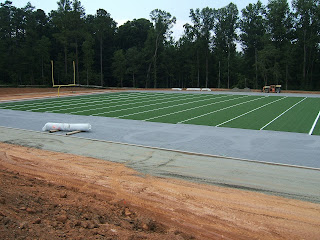
Norfolk, Va. – With two days remaining before the Old Dominion University football team hits the field for its first practice, workers are nearing completion on the two new AstroTurf GameDay Grass 3D fields that the Monarchs will use for practice. One field will be a regulation size 100 yards and the other will be a shortened 60-yard field.

The GameDay Grass 3D fields were supplied by GeneralSports Venue (GSV), a certified minority business enterprise and the exclusive U.S. marketer of AstroTurf-branded products. GameDay Grass 3D is one of the most advanced synthetic turf products, featuring best-in-class performance and safety benefits, and characteristics that closely mimic the look and feel of natural grass.

A recent study released by Michigan State University and funded by the NFL Charities Foundation revealed that GameDay Grass 3D most closely replicated natural grass in a comparison of 16 types of synthetic and natural sports turf, based on the torque, force and friction generated by cleated athletic shoes. The study evaluated the potential impact of football playing surfaces on lower extremity injuries caused by excessive torque, or the rotational friction produced when cleated shoes dig into the field. The GameDay Grass 3D system with all-rubber infill had the lowest average torque of all synthetic turf systems tested, second only to natural grass.

To assist in preventing injury, GameDay Grass 3D utilizes a proprietary technology called RootZone, a nylon thatch layer at the base coupled with a monofilament polyethylene long fiber, that replicates natural grass. The density of the RootZone, providing stability, cushion and consistent performance, means that less granulated infill is required, reducing the problems related to infill migration and “fly-out”. The nylon-polyethylene hybrid construction also serves to increases durability and overall system performance.

The installed base for GSV is now well over 150 fields including projects for the likes of Florida State, the University of Texas, the Washington Redskins and the Buffalo Bills.

Wednesday, August 6, 2008

Michigan State University study ranks GameDay Grass 3D closest to natural grass

AstroTurf’s GameDay Grass and Field Turf at Opposite Ends of Findings Presented at the North American Congress on Biomechanics


According to the results of a year-long Michigan State University study, which was selected for presentation today at the North American Congress on Biomechanics Conference in Ann Arbor, Michigan, Astroturf’s GameDay Grass 3D most closely replicated natural grass in a comparison of 16 types of synthetic and natural sports turf, based on the torque, force and friction generated by cleated athletic shoes.

The study, funded by the NFL Charities Foundation, evaluated the potential impact of football playing surfaces on lower extremity injuries caused by excessive torque, or the rotational friction produced when cleated shoes dig into the field.

“This highly anticipated study validates the introduction of new technologies by AstroTurf, such as GameDay Grass 3D with Root Zone®, to enhance player performance and safety,” said Jon Pritchett, CEO of GeneralSports Venue (GSV), the exclusive licensee of the AstroTurf brand in the U.S. “It is indicative of our continued dedication to be the leading innovator in synthetic sports turf.”

In the Michigan State study, the GameDay Grass 3D system with all-rubber infill had the lowest average torque of all synthetic turf systems tested, second only to natural grass. Researchers credited the fiber structure of the GameDay Grass 3D system, the only fiber structure containing a Root Zone – a simulated thatch layer at the base of the system – with the low level of frictional resistance. Researchers also noted that the Root Zone reduces the amount of infill required for a stable system and may reduce compaction of the infill layer.

The high amount of torsional friction generated in high-performance sports creates concentrated force that is transmitted to vulnerable ankle and knee joints, precipitating injuries. The Michigan State research team used 10 pairs of cleated football shoes in conducting five trials on 16 separate playing surfaces, for a total of 800 samples. The study measured the mean peak torque produced by various shoe/surface interfaces.

The research summary indicated that the highest mean torque was produced by the Field Turf system, a result attributed to the amount of space, or gauge length, between the rows of fibers. According to the study, the greater gauge length in the Field Turf system (3/4” versus 3/8” in all other systems tested) may result in deeper cleat penetration into the infill and, in the case of densely compacted infill, higher torque.


“According to this study, the risk of injury due to increased stress on knee and ankle joints is elevated on artificial turf systems that have less fiber and more infill, and have a greater potential for compaction,” said Dr. Rod Walters, President of Walters Inc., Consultants in Sports Medicine, and former Director of Sports Medicine at the University of South Carolina. “The good news is that breakthrough innovations such as the Root Zone in AstroTurf’s GameDay Grass 3D represent a significant advancement in the evolution of synthetic turf, making it much more realistic and forgiving than most of the standard artificial turf systems currently in use, something that coaches, athletic trainers and athletes should be very excited about.”

The North American Congress on Biomechanics (NACOB) is the combined annual meetings of the American Society of Biomechanics and the Canadian Society for Biomechanics. It is held jointly every six years to promote the exchange of ideas and foster new collaborations in the field of biomechanics.

Tuesday, August 5, 2008

Fellowship Christian's new GameDay Grass field coming together

After a breakout season in 2007, winning 11 games and advancing the to Georgia Class A state quarterfinals for the first time in school history, Fellowship Christian is on the verge of yet another milestone.


The Paladins will play their first home game on their new state-of-the-art GameDay Grass XPe field on September 6th when they host Prince Avenue Christian.


With new head coach, former NFL player Terry Luck, the Paladins look to continue their rise in hopes of playing in the Georgia Dome for a State Championship this December.


AstroTurf

"This is not your father's AstroTurf" - Archie Manning