Wednesday, August 27, 2008

Rebels Continue To Works Towards Memphis

After a day off Monday, the Ole Miss football team returned to practice Tuesday afternoon as the team continues to work towards the opening game Saturday evening against Memphis.

“It was a good practice today,” Ole Miss head coach Houston Nutt said. “This is the first time that we had school and practice on the same day. We never practice on the first day of school because we like to let them have that first day to be a true student. For the most part I was pretty proud of them because we had a good practice.”

Nutt went on to acknowledge that his team has been hit by the injury bug a bit this preseason, but that he is still looking for everyone to step up against Memphis.

“We’re asking a lot out of everyone, especially the ones that have to fill in for Peria (Jerry) and Greg Hardy because those are big shoes to fill,” Nutt said. “The offense also needs to step up because we are expecting them to stay on the field and take care of the ball.”

Other than the losses of Jerry and Hardy, Nutt discussed that nearly everyone else appears to be healthy heading into Saturday’s contest.

“We’re starting to get healthy now,” Nutt said. “I told the guys Sunday night that we have had all the injuries for the year and that’s all over. No one else can get hurt because we’ve had enough.”

On offense, Nutt continues to express his pleasure with junior running back Cordera Eason.

“He has been very ball-conscious and he has done it will competition,” Nutt said. “He knew he was going to get competition from some freshmen, but he hung in there and has been very mature about it.”

Nutt also addressed how much playing time can be expected from each string of offense and defense in Saturday’s game.

“It’s whoever is hot and whoever has that feel is who I am going to go with,” Nutt said. “We have told everyone that you never know when your opportunity is going to come. But when it does come, protect the ball, go play as hard as you can and just let the game happen.”

Kickoff for Saturday’s game is slated for 6:00 p.m. from Vaught-Hemingway Stadium.


Since 2003, Vaught-Hemingway Stadium and the attached indoor-practice facility at Ole Miss have been equipped with GameDay Grass from AstroTurf.


Burges Mustangs excited to break in new GameDay Grass field


By Aaron Bracamontes / El Paso Times

Last year, the Burges High School football team didn't have it easy. The Mustangs even had to play their home games on the road, and they finished sixth in district 1-4A with a 2-5 record, 4-6 overall.

This year, not only will there be football played at Mustang Stadium, it will be played on top of brand-new artificial turf.

The players are looking forward to using the home field advantage to its fullest potential, said senior running back Josh Ingo.

"There's a lot of motivation with the guys," he said. "They want to play on the turf."
Third-year head coach Lloyd Smith said the new turf helps the team's ever-growing positive attitude.

"We're trying to give the kids pride in being a Mustang," he said. "Their mind-set is changing and becoming more competitive."

The team is optimistic this year, despite being young, because of their growing confidence, Smith said.

"They're very coachable and upbeat kids," he said.

The team has six starters returning on each side of the ball, including Ingo (5-9, 190), who also will play defensive back, and Matt McBain, (6-3, 255), a three-year letterman and pre-season all-state selection by Dave Campbell's Texas Football Magazine.

Both Ingo and McBain earned all-district and all-city honorable mention last year.
McBain, who is also an offensive lineman, said he thinks the Mustangs will be a surprise contender this year.

"Burges always seems to be taken lightly," he said. "We're looking to change that this year."

He also knows that his all-state selection may have just put a bullseye on his uniform, but he doesn't mind.

"I'll be ready for them," he said.

The team will be young this year, but McBain said they are better than last year.

"From the beginning of spring to the end of summer, we've come a long way," he said.
The team's strength will be the defense, Smith said.

"We try to play very aggressive and get to the ball often," he said. "We want to do what we can to stop the run or limit it."

On offense, Smith said, his team will focus on smart play while controlling the clock and field possession to win games.

"We don't have that big breakaway playmaker on the team this year," he said.
Ingo will be asked to make plays at running back, but will have the advantage of McBain blocking for him. "It's the greatest feeling when I'm running behind him," he said. "I'm going to try my best and with an offensive line like mine, it won't be too hard."

Tuesday, August 26, 2008

Tuscola Dominates in Season Opener on new AstroTurf field

The Tuscola Mountaineers (NC) got the 2008 season off to a great start with an impressive 36-7 win over a quality East Henderson team. The offense did well tonight, showing strength in the running game. The defense also showed up well and was able to stop the speedy Michael Robinson and talented Chase Hill.

The Mountaineers win at C.E. Weatherby Stadium was their first on the new state-of-the-art GameDay Grass XPe field.

Coach Donnie Kiefer talks about the win and playing on AstroTurf GameDay Grass XPe


Tuscola Football Website

GSV and AstroTurf featured in INC Magazine

Jon Pritchett's Dream of Reviving AstroTurf Became a PR Nightmare
Should he go all out to save the brand?


By: Andrew Park
Published September 2008


In the fall of 2007, New Jersey state health officials made a troubling discovery: A playing field at a Newark park contained extremely high levels of lead. They assumed the contamination was coming from the abandoned scrap-metal yard next door. But the problem turned out to be deep in the fibers of the artificial turf covering the field. When the news broke the following spring, it set off a nationwide scare, and for tiny GeneralSports Venue, a public-relations nightmare.

The company, a five-year-old artificial-turf supplier with 42 employees, wasn't at fault. But the brand name it had just adopted was. GeneralSports had acquired an exclusive license on the name AstroTurf -- the same one used by the now-defunct company that had manufactured the Newark field almost a decade earlier -- and had spent millions of dollars to resurrect it. But now that familiar name was at the center of fears about the safety of playing fields, and GSV's big investment was suddenly at risk. "I'm a parent, and if you think about children, turf, and lead, it's pretty scary," says Jon Pritchett, the company's co-founder and CEO. "Not a whole lot more needs to be said."

Just how much more to say was, in fact, the critical question. On the one hand, it's rarely advisable for a company to keep quiet in a crisis. But no one was claiming that GSV was responsible for products made long ago by another company. So, anything it said risked drawing even more negative attention. Yet the AstroTurf name, which to many is synonymous with all brands of artificial turf, was being invoked in every story about the lead scare, often erroneously. Could GSV really stay silent while AstroTurf was trashed?

The granddaddy of fake grass was invented by Monsanto and was a household name from the moment it was rolled out in the Houston Astrodome, in 1966. The brilliant-green carpet became the surface of choice for America's new climate-controlled domed stadiums. But by the 1990s, AstroTurf started to fade. Athletes complained of injuries suffered on the abrasive, unforgiving nylon, and a softer polyethylene turf marketed by rival brand FieldTurf became the industry standard. AstroTurf changed hands twice, and in 2004, its owner filed for bankruptcy.

At the time, GSV was a bit player in the artificial-turf business. The company was formed when Pritchett, a sports marketing executive who worked in the University of South Carolina's athletic department while getting his M.B.A., hooked up with Michigan sports and entertainment entrepreneur Andy Appleby. With a business plan based on consolidating a fragmented but growing market, they raised $3 million from investors, including a New Jersey telecom executive named Michael Dennis.

But the company's brand struggled to gain traction against FieldTurf. In 2006, sensing that AstroTurf's worldwide name recognition could vault it into contention, GSV negotiated a license lasting 50 years with the brand's owner, Textile Management Associates, which continued to handle manufacturing.

Pritchett quickly set about bringing AstroTurf back, starting with an announcement in December 2006 at the ESPN Zone restaurant in New York City's Times Square. GSV rebranded its existing product line and hired a national sales force. An ad campaign emphasized the storied brand's place in sports history and its new, cushier, player-friendly surface. Pritchett even hired football great Archie Manning, father of NFL stars Peyton and Eli, to be AstroTurf's brand ambassador. By the end of 2007, sales were up 67 percent, to $25 million, and were projected to hit $40 million in 2008. With 10 percent of the market, up from less than 2 percent in 2006, AstroTurf now trailed only FieldTurf.


Then, during a March 12 staff conference call, Pritchett was notified about the lead discovery in Newark. GSV believed its current products were safe, but it couldn't vouch for AstroTurf installed by others years earlier. GSV began gathering information from industry experts as well as its own suppliers, trying to understand the depth of the problem.

But AstroTurf's troubles grew. On April 14, the New Jersey state health department announced it had tested 12 more artificial-turf fields for lead and found two with levels eight to 10 times what it considered safe. As in Newark, both were nylon fields, and both were AstroTurf. The state's top epidemiologists called for a federal investigation into the safety of artificial turf.

Media across the country picked up the story of New Jersey's toxic turf, with television footage showing workers wearing protective green suits as they tore up the field in Newark. Elsewhere, fields were padlocked, events were canceled, and school board hearings were held. "Our thinking was this could last long enough that it could do a lot of damage," says Pritchett.

GSV spent the next seven days in near-constant deliberations. At the table were Pritchett's management team and legal counsel, AstroTurf's manufacturer, and GSV's PR firm. Initially GSV had let the Synthetic Turf Council, the industry's trade association, respond publicly. But Pritchett knew that the council couldn't be expected to offer a vigorous defense of a single member's brand. For that, the company would have to step out on its own.

Yet doing so risked heightening the unwanted scrutiny on AstroTurf and making the brand an even bigger lightning rod. GSV wasn't responsible and could be forgiven for keeping quiet, it was pointed out. And though some GSV executives wanted to come out swinging, Michael Dennis argued for taking the high road. "We all took it personally," says sales and marketing manager Philip Primato. "We had put so much into building this brand back that we were not going to let something like this stop us."

The Decision Pritchett opted for going on the offensive. GSV spent the next 10 days planning a major press conference for May 5, at which four company-retained scientists would present their findings. The venue, the New York Public Library for Science, Industry and Business, was chosen to reinforce the scientists' message. The team worked hard to distill the data to a form the public could easily absorb. No one disputed the source of the lead: the pigment that gives artificial turf its green-grass color and that the industry has been trying to eliminate. But GSV's panel argued that, even in older turf, the lead compound was encapsulated before being extruded into the fibers. So it would be impossible for lead to leach from an AstroTurf-covered field. Even if those fibers were somehow ingested, the amount of lead they contained was much too small to be dangerous. A 100-pound child would have to eat 23 pounds of AstroTurf before it would pose a health hazard, they said.

The press conference attracted reporters from more than two dozen media outlets, including USA Today. That night, sitting with Pritchett on the patio of Dennis's home in Chester, New Jersey, Primato pulled up the newspaper's website on his laptop. The front page of the sports section featured a story about the press conference and a photo showing the 23 pounds of AstroTurf GSV had dumped in front of the podium for effect. For at least a moment, the company had seized control of the spotlight.

In the following days, press reports were less alarmist. Pritchett says he believes GSV's willingness to confront the issue head on defused the PR fallout. And when the final results from the state's tests on the three fields with high lead levels came out, in early June, the findings seemed to support GSV's position, showing an even smaller threat of lead exposure than GSV's estimates.

GSV was even chosen to replace the field in Newark that had started it all, after Dennis lobbied for the contract. "Our reputation was on the line," says Dennis, now the company's majority shareholder. "I was not going to let it be replaced with a competitive product." Still, the fight isn't over. In June, the Centers for Disease Control issued a health advisory, urging caution before letting children play on artificial turf. Earlier, the Consumer Product Safety Commission began a separate investigation.

Pritchett maintains that by taking the initiative in the lead scare, GSV positioned itself as more than just the caretaker of an aging brand. "It tested us," he says. "I wouldn't want to do it again, but I do think it helped us."


Video from New York City Press Conference

Monday, August 18, 2008

Campbell Football Holds Second Fall Scrimmage

After completing a week of full contact practice, Campbell football held its second scrimmage of fall camp on Saturday, readying for the team’s long awaited Aug. 30 matchup with Birmingham-Southern.

Several Fighting Camels took the spotlight during the open afternoon session, which included various situational plays to prepare the young squad.

Under center, Wesley Snow and Matt Vollono received almost equal time on the field, with the duo passing 19 and 17 times, respectively. Snow connected on nine occasions for 48 yards and a touchdown, while Vollono threw for 86 yards on six completions with an interception.

Carl Blain led the Camel receiving core with three catches and 43 yards, including a 26 yarder from Vollono to set up a Bobby Pina field goal. Paul Constantine accounted for the Camels only receiving touchdown.

Three running backs posted at least 50 yards on the afternoon, with Taylor Cabral, Carl Smith and Rashaun Brown taking the majority of hand-offs.

Cabral’s 86 yards on 12 carries were highlighted by numerous pounding runs through the middle, including a two yard play to reach pay dirt. The Tampa, Fla. native also showed speed around the tackles, breaking for four plays of 10 or more yards, including a 35 yarder. Brown also pounded the ball through the defense, compiling 53 yards on 11 carries that included a seven yard touchdown run.

Posting a pair of touchdowns to lead the Camel offense, however, was Smith, who quickly scampered for 54 yards on six attempts, averaging over nine yards per carry on the afternoon. Three of Smith’s six carries went for at least 15 yards, including both scoring runs.

Defensively, linebacker Milton Brown led the way, posting a team-high five tackles, while lineman Freddie Mungo recorded a pair of sacks. Erik Feliciano, Randal Herring and Will Phillippi also notched sacks on the day.

Six other Camels racked up three stops a piece, with Herring, Chad McDuffie, Brad Brower, Cody Lyon, James McCreary and Matt Baker joining the mix. Defensive backs Lyon and Baker were effective in punt situations as well, blocking consecutive attempts. Both McCreary and Kevin Miller ended their afternoons with interceptions to aid the Camel defense.

The Fighting Camels will continue fall camp for the next two weeks, in preparation for their opening kickoff in Buies Creek on Aug. 30.

ODU Football Camp Report - Aug. 17


Day four of the Old Dominion University preseason football camp saw the Monarchs continue to improve in nearly every segment, but the most memorable moment of the day came during a special teams period.

While working on punt protection and coverage linebacker EJ Watts, formerly of Powhatan High School, stepped in as the punter on the final snap of the period. Watts was an all-district punter in high school and he showed why by launching a kick 60 plus yards, to the enjoyment of the entire team. He had been punting along with the kickers during the week, serving mostly as an extra leg during special teams drills, but even then he had been routinely punting between 40-45 yards.

Not to be outdone, punter Benjamin Knerr also had a solid day averaging 40 plus yards as well.
At the quarterback position Bobby Cooper and Dan Pitts both looked good at times and it was evident that they're becoming more comfortable each day. Working with the first team, Cooper showed that he has a strong arm and can make all of the throws, one in particular he squeezed in between defenders during 7-on-7. During the 1-on-1 session Pitts was picked off by Donald Smith on one play, but quickly bounced back to make two great throws including a touchdown pass to Chris Lovitt who had gotten behind DeAnthonyJones.

The Monarchs will be in full pads tomorrow for the first time when practice resumes at 9 a.m.
A reminder that due to safety concerns ODU football practices are CLOSED to the public. Fans will have the opportunity to see the Monarch football team during one of the three scrimmages this fall.

Dekker prefers Heinz Field

By Ed Bouchette, Pittsburgh Post-Gazette

All things considered, tight end Jon Dekker prefers the grass at Heinz Field, no matter the condition. Dekker will have surgery in a week to repair a torn ACL in his right knee, which occurred on what the players say was a poor playing surface at the Rogers Centre in Toronto.
"It was non-contact. I was just planting and trying to cut on it," Dekker said. "It gave way. I knew it the second it happened."

The Steelers yesterday placed Dekker on the waived/injured list. As long as he clears waivers, he could rejoin the team later on their injured-reserve list. They signed tight end Lee Vickers to replace him and also waived defensive end Kevin Huntley after he failed their physical. They claimed him off waivers last week from the Redskins.

Dekker was bidding to make it as the third tight end.

Quarterback Ben Roethlisberger yesterday cited the poor playing surface in Toronto, where old, worn-out FieldTurf is rolled in and out by sections.

"I don't think many guys liked playing on it," Dekker said.

Fox Sports reports on Michigan State Study

Rick Horrow, The Sports Professor, discusses Brett Favre to the Jets and the effects of the Michigan State University study on synthetic turf surfaces on the NFL in his latest Sports Business Minute on FoxSports.com.


Pro Football Business Minute

Friday, August 15, 2008

GameDay Grass field "saved" Florida State football practice

Thank goodness for AstroTurf GameDay Grass at Florida State University. On Wednesday, the Seminoles football team practiced on the band field. Head Coach and College Football Hall-of-Famer Bobby Bowden said "the synthetic turf saved us today because our fields got drenched." Tallahassee received nearly 3 inches of rain on Tuesday.


The Seminoles chose GameDay Grass XPe for their practice/band field in 2005. The field, which is marked identical to the playing field at Doak Campbell Stadium, is used for band practice and football practice.

GSV's Response to a FieldTurf Statement attempting to discredit a Michigan State University Study

Despite not having read the scientific study produced by Michigan State University’s Orthopaedic Biomechanics Laboratory, under the direction of Dr. Roger Haut and Dr. John Powell, which was recently presented at the North American Conference on Bio Mechanics, FieldTurf attempted to discredit the work. It is worth noting that this research was not only overseen by some of sports medicine’s most experienced and respected academicians, it was also funded by the NFL Charities Foundation…not by GSV or AstroTurf.

FieldTurf claims that this study is "junk science". An opinion that they are certainly free to express, but that is absurdly wrong and wholly disrespectful to both the highly accredited research team and the NFL itself.

While the research was narrowly focused and did not attempt to answer broad questions, it certainly adds to the body of knowledge in the continuing pursuit for more understanding of the interface between athletes, shoes and synthetic turf. The study conducted by Michigan State University was under the watchful eye of Dr. John Powell, who has been a leading researcher and medical advisor for the National Football League, working with the league in the study of injury rates since 1980.

Dr. Powell is an Associate Professor in the Department of Kinesiology and Physical Medicine & Rehabilitation and directs the graduate athletic training educational and research program. Dr. Powell was instrumental in researching and guiding the preparatory phase of the undergraduate educational athletic training program development at Michigan State University. Dr. Powell is currently involved in extensive research in the area of injury prevention, sports injury epidemiology and the biomechanics of lower extremity injuries.

Dr. Powell is a consistent professional reviewer for the Journal of Athletic Training, American Journal of Sports Medicine and Medicine and Science in Sport. He was named the 2000 recipient of the William G. Clancy Jr. M.D. Medal for Distinguished Athletic Training Research by the NATA Research and Education Foundation. Dr. Powell was named a 2005 recipient of the National Athletic Trainers’ Association (NATA) Most Distinguished Athletic Trainer Award. In 2006, he was inducted as a Fellow in the American Academy of Kinesiology and Physical Education. Dr. Powell earned his Bachelors of Science Degree from Michigan State University, his Masters of Science degree from Indiana University, and his Doctor of Philosophy from Penn State University.

FieldTurf also claims that the independent third party study was funded by GSV. While a clever attempt to deflect attention from the results of the study, the claim is completely false. In fact, this study was funded by the NFL Charities Foundation.

Each year, the NFL Charities Foundation awards $1.5 million in sports-related medical research grants that target sports injury prevention, injury treatment, and other related research that affects the health and performance of athletes. GSV and AstroTurf did not fund the research nor were they allowed to have any input into the criteria, methodology, assumptions or conclusions. We did contribute materials and installation of some of the turf systems that were analyzed in order to learn more about how our newer products are performing in this important area. This contribution did not affect or impact any opinions reflected in the MSU study.

The National Football League is committed to supporting research and enhancing the body of scientific knowledge that will benefit all those involved in competitive sports and recreational athletic activities. Funding is available for non-profit educational and research institutions only. For-profit enterprises are not eligible to apply in this grant category. Over the past four years, the NFL Charities Foundation has awarded grants for 60 different scientific studies and research opportunities. To learn more, visit the NFL Charities Foundation website

Despite claims by FieldTurf, the Michigan State University abstract was peer reviewed and the formal study is currently under peer review for publication in the Journal of Sports Engineering and Technology, which aims to become the publication of choice for authors to disseminate, original research findings related to the development or application of technology in sports.

Finally, FieldTurf claims that the surfaces tested were "newly installed sections of turf". The FieldTurf system tested was a 5–year-old game field. The AstroPlay field tested was a 6-year-old practice field. The GameDay Grass XPe and 3D systems tested were a year-old and serve as a practice field for the football team. The natural grass system tested was the Spartan Stadium field at MSU, which was named the Stadium Field of-the-Year by the STMA in 2006.


In conclusion, the opinions set forth in the Michigan State University study are a culmination of extensive, scientific-based research conducted by highly credentialed academicians who were not influenced by others. Michigan State University and the NFL have done many such research projects in the past that contribute to the body of knowledge in the specific area of orthopedic biomechanics. GSV and AstroTurf will continue to pursue answers and questions in a quest for improving performance and safety of synthetic turf systems. Whether that research is through third parties, the academic community, strategic allies, supply chain partners or self-performed, we are in pursuit of the data and information that leads to improving products for our customers. That pursuit does not stop with biomechanics. We will also continue our pursuit of improvements in integrated manufacturing, fabrication, installation, financing, environmental stewardship and customer service. We reject the idea that only one large company has the answers to these and many questions that need to be answered. We also reject the supposition that such company’s product is the best simply because they say it is or because it was the best alternative ten years ago.

Wednesday, August 13, 2008

Turf Installation Nearing Final Stages As Monarchs Prepare For Practice


Aug. 12, 2008

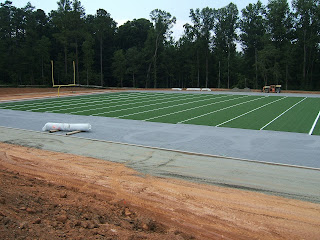
Norfolk, Va. – With two days remaining before the Old Dominion University football team hits the field for its first practice, workers are nearing completion on the two new AstroTurf GameDay Grass 3D fields that the Monarchs will use for practice. One field will be a regulation size 100 yards and the other will be a shortened 60-yard field.

The GameDay Grass 3D fields were supplied by GeneralSports Venue (GSV), a certified minority business enterprise and the exclusive U.S. marketer of AstroTurf-branded products. GameDay Grass 3D is one of the most advanced synthetic turf products, featuring best-in-class performance and safety benefits, and characteristics that closely mimic the look and feel of natural grass.

A recent study released by Michigan State University and funded by the NFL Charities Foundation revealed that GameDay Grass 3D most closely replicated natural grass in a comparison of 16 types of synthetic and natural sports turf, based on the torque, force and friction generated by cleated athletic shoes. The study evaluated the potential impact of football playing surfaces on lower extremity injuries caused by excessive torque, or the rotational friction produced when cleated shoes dig into the field. The GameDay Grass 3D system with all-rubber infill had the lowest average torque of all synthetic turf systems tested, second only to natural grass.

To assist in preventing injury, GameDay Grass 3D utilizes a proprietary technology called RootZone, a nylon thatch layer at the base coupled with a monofilament polyethylene long fiber, that replicates natural grass. The density of the RootZone, providing stability, cushion and consistent performance, means that less granulated infill is required, reducing the problems related to infill migration and “fly-out”. The nylon-polyethylene hybrid construction also serves to increases durability and overall system performance.

The installed base for GSV is now well over 150 fields including projects for the likes of Florida State, the University of Texas, the Washington Redskins and the Buffalo Bills.

Wednesday, August 6, 2008

Michigan State University study ranks GameDay Grass 3D closest to natural grass

AstroTurf’s GameDay Grass and Field Turf at Opposite Ends of Findings Presented at the North American Congress on Biomechanics


According to the results of a year-long Michigan State University study, which was selected for presentation today at the North American Congress on Biomechanics Conference in Ann Arbor, Michigan, Astroturf’s GameDay Grass 3D most closely replicated natural grass in a comparison of 16 types of synthetic and natural sports turf, based on the torque, force and friction generated by cleated athletic shoes.

The study, funded by the NFL Charities Foundation, evaluated the potential impact of football playing surfaces on lower extremity injuries caused by excessive torque, or the rotational friction produced when cleated shoes dig into the field.

“This highly anticipated study validates the introduction of new technologies by AstroTurf, such as GameDay Grass 3D with Root Zone®, to enhance player performance and safety,” said Jon Pritchett, CEO of GeneralSports Venue (GSV), the exclusive licensee of the AstroTurf brand in the U.S. “It is indicative of our continued dedication to be the leading innovator in synthetic sports turf.”

In the Michigan State study, the GameDay Grass 3D system with all-rubber infill had the lowest average torque of all synthetic turf systems tested, second only to natural grass. Researchers credited the fiber structure of the GameDay Grass 3D system, the only fiber structure containing a Root Zone – a simulated thatch layer at the base of the system – with the low level of frictional resistance. Researchers also noted that the Root Zone reduces the amount of infill required for a stable system and may reduce compaction of the infill layer.

The high amount of torsional friction generated in high-performance sports creates concentrated force that is transmitted to vulnerable ankle and knee joints, precipitating injuries. The Michigan State research team used 10 pairs of cleated football shoes in conducting five trials on 16 separate playing surfaces, for a total of 800 samples. The study measured the mean peak torque produced by various shoe/surface interfaces.

The research summary indicated that the highest mean torque was produced by the Field Turf system, a result attributed to the amount of space, or gauge length, between the rows of fibers. According to the study, the greater gauge length in the Field Turf system (3/4” versus 3/8” in all other systems tested) may result in deeper cleat penetration into the infill and, in the case of densely compacted infill, higher torque.


“According to this study, the risk of injury due to increased stress on knee and ankle joints is elevated on artificial turf systems that have less fiber and more infill, and have a greater potential for compaction,” said Dr. Rod Walters, President of Walters Inc., Consultants in Sports Medicine, and former Director of Sports Medicine at the University of South Carolina. “The good news is that breakthrough innovations such as the Root Zone in AstroTurf’s GameDay Grass 3D represent a significant advancement in the evolution of synthetic turf, making it much more realistic and forgiving than most of the standard artificial turf systems currently in use, something that coaches, athletic trainers and athletes should be very excited about.”

The North American Congress on Biomechanics (NACOB) is the combined annual meetings of the American Society of Biomechanics and the Canadian Society for Biomechanics. It is held jointly every six years to promote the exchange of ideas and foster new collaborations in the field of biomechanics.

Tuesday, August 5, 2008

Fellowship Christian's new GameDay Grass field coming together

After a breakout season in 2007, winning 11 games and advancing the to Georgia Class A state quarterfinals for the first time in school history, Fellowship Christian is on the verge of yet another milestone.


The Paladins will play their first home game on their new state-of-the-art GameDay Grass XPe field on September 6th when they host Prince Avenue Christian.


With new head coach, former NFL player Terry Luck, the Paladins look to continue their rise in hopes of playing in the Georgia Dome for a State Championship this December.


Monday, August 4, 2008

Opening lead-free Newark ballfield


by Christopher Dela Cruz/The Star-Ledger

The rain poured down on the newly renovated Ironbound Athletic Field in Newark, but that didn't stop swarms of soaked kids from kicking soccer balls and throwing footballs. They had waited long enough.


Moments before the rain, an excited Cory Booker, mayor of Newark, addressed local sports clubs announcing the reopening of the complex in the Ironbound that was closed for rehabilitation after lead was discovered at the site a year ago.

"It may be raining in a few minutes, but the sun is shining in Newark, New Jersey," said Booker, to a crowd of about 100 roaring children athletes and rejuvenated parents. "This is truly a field of dreams."


The city celebrated the $2.2 million renovation Saturday, holding a parade from Peter Francisco Park outside Penn Station down Ferry Street to the field.


The new field has an additional soccer field, a baseball field, a new basketball court, concession stands and benches. Now, Little League players can also use the field, which has the requisite 90-foot base paths for the 13-and-older set.


The field also has a new synthetic turf with a drainage system that can be used even on rainy days like Saturday. Officials said the city plans to put up new batting cages, more concession stands and bathroom facilities.


Teams in the area will meet and discuss schedules for the fall, officials said.


The Ironbound Athletic Field, known as the "B" field, was shut by Newark officials in October after testing by the Environmental Protection Agency revealed lead in the field's dust. City officials later learned the lead came from the green synthetic turf installed 10 years ago.

"We've turned an obstacle into an opportunity," said Booker.


Abdul Ahmad, head coach of the local Pop Warner football team East Ward Stallions, said the reopened complex will provide a haven for city children.


"The gangs are taking over the streets," said Ahmad. "They don't have too many outlets. This definitely is a blessing."


Dora Fernandes, parent of an Ironbound Soccer Club Rebels player, said the renovations make the complex much safer for kids tackling and sliding in games.


"The turf itself is way better," said Fernandes. "It looks much nicer and cleaner."


And for many athletes like 10-year-old Ronaldo Lopez, a member of the Ironbound soccer team, the renovated facility provides a steady base for teams who have been jumping between various shoddy fields in the area.


"Now we have a new home," said Lopez. "I thought it looked awesome."

Friday, August 1, 2008

Ironbound on verge of scoring a revamped field for athletics


by Carmen Juri/The Star-Ledger


Standing on the Ironbound Athletic Field, Newark chief architect Robert Dooley said the discovery of lead at the site last fall was a blessing in disguise.


The detection led to a $2.2 million renovation at the St. Charles Avenue field that includes a new synthetic turf with a drainage system that can be used even on rainy days. That's just one perk.
The new field has an additional soccer field, a baseball field, play ground, a new basketball court, batting cages, restrooms, concessions stands and benches. Now, Little League players can also use the field, which has the requisite 90-foot base paths for the 13 and older set.


''The Ironbound will be doing pretty well," Dooley said.


The field officially reopens Saturday though construction is still ongoing on some areas, including the playground and concession stands. Local sports clubs will parade from Peter Francisco Park outside Penn Station down Ferry Street to the field, for the daylong reopening ceremonies that begin at 11 a.m.


The Ironbound Athletic Field, known as the B field, was shut by Newark officials in October after testing by the Environmental Protection Agency revealed lead in the field's dust. City officials later learned the lead came from the green synthetic turf that was in stalled 10 years ago.


The EPA was conducting a field investigation on the adjacent contaminated Tidewater Bailing property when lead in the field's dust and synthetic fibers were discovered. The field was later carefully removed, which included fencing in the area and keeping the dust down during the removal.


Dooley said the city has been meticulous in ensuring the safety of the new AstroTurf field by hiring two firms to test the field: Weston Solutions; and Environmental and Occupational Health Sciences Institute. The turf's lead content is 100 times lower than the standard acceptable amount, he said. The standard is 40 micrograms per square feet and the field's numbers are .01 to .5 micrograms, he said.


Workers took samples from the field during a four-week period after its June installation, Dooley said.


''It took us longer to do it, but we're very accountable the way we approached it," he said. "It's lower than a child's toy is allowed to be."


Dooley said the city has tried to brand all parks with the same style of fencing, gates, benches, trash receptacles, lighting and brick pillars, with only the colors altered to match the immediate neighborhood.


''There are common elements in all," said Dooley. "

Mayor Cory Booker said the field is a state-of-the-art recreational facility.

''This reopening is another step forward in our continuing efforts and historic plan to rebuild and transform the parks and recreation facilities in all of our neighborhoods throughout the city," Booker said.


In the Ironbound, where a large Brazilian and Portuguese population has made soccer the choice sport, the new field is a godsend. The Ironbound Soccer Club has 1,000 members, and some 300 kids play for the Den of Lions. Most teams double or triple up because of lack of practice space.
Joe Manso, coach for the Sport Club Portuguese soccer league said he is excited that there will be a site close to home for his adult division to practice. His teams have had to practice at out of the way locations like West Side Park.


''Ironbound (field) is walking distance from our club," Manso said. "Before, the field was very beat up, it's harder on the knees. They're putting in benches and bathrooms. I didn't have that for the last 15 years."


Unlike the case at county parks, where teams must pay about $1,600 a season for permits, city parks are free, he said.


''Now we'll have accessibility of scoreboards, bathrooms," said Mike Alban, president of the Ironbound Little League.


East Ward Councilman Augusto Amador said the anticipation in his neighborhood is palpable.


''When I met with all the clubs, you could sense the excitement in the room from all the directors," he said. "The community has a shortage of open space and areas of recreation. This will fill, to a certain ex tent, the needs of that community.


''We still need more facilities, but this helps a lot," he said.

First ODU practice nears, first schedule set


The only thing missing is 80 big, sweaty bodies.


That's how many players will report Aug. 13 as members of Old Dominion's first I-AA football team.


On Thursday, the Monarchs finalized their schedule for 2009, when ODU will field a team for the first time since 1940. The school's shiny athletic showplace, the $17 million Powhatan Sports Complex, is awaiting everyone's arrival.


Dark blue leather chairs sit obedient and empty in front of oak tables in team meeting rooms (in addition to a spacious area for players, the offensive and defensive coaching staffs have their own enclaves). Footsteps echo through the locker room, where large wooden lockers with built-in fans to dry shoulder pads and cleats and coated with an anti-microbial laminate stand at the ready. Two huge washing machines, each capable of holding 275-pound loads (and a 135-pound model strictly for coaches' gear) face three gigantic dryers, each with a 125-pound capacity.


It doesn't take much imagination to replace the hard hats strewn across desks with helmets and the sound of jackhammers laboring outside with clacking cleats. But Bobby Wilder is ready for the reality of a building full of players.


"I can't wait," said Wilder, named ODU's head coach in February 2007 after 17 years as an assistant at the University of Maine. "It's the date that all of us as coaches have been targeting since last year, when we set Aug. 13 as the report date. It's what we've all been looking forward to. We're gonna have 80 players walk through the door and come and be part of our first team, our first family."


The Monarchs rounded out their first schedule Thursday, announcing home games against Virginia Union on Sept. 12 and Campbell on Oct. 17 and a trip to Iona on Nov. 14.


Players, who will redshirt this season, will take physicals and pick up equipment Aug. 13 before getting down to business with their first practice Aug. 14. Two-a-days begin Aug. 19.


After spending his first year with the Monarchs selling the program to the community in speaking engagement after speaking engagement — 240, to be exact — Wilder is eager to trade the microphone for his whistle.


"It's been challenging. I'm not gonna lie to you," he said. "I've gone through 18 months of not being a coach. ... To put a whistle around my neck and go be a ball coach — that's the part I miss the most."Construction is racing ahead on the Monarchs' practice fields, currently defined by mounds of gravel. A quarter of a mile away, a $24.8 million renovation is beginning at Foreman Field, which will boast 24 luxury suites, a new parking deck and a state-of-the-art AstroTurf 3D surface when ODU kicks off against Chowan on Sept. 5, 2009.


"The first game and running through the tunnel, leading the team out onto the field ... as a coach, that's what you love," Wilder said. "It's that competition. It's the excitement of putting a plan together, and the plan works. All the rest of what we do the other 354 days, that's just to get to those 11 days when you're doing what you love. "I think about that all the time. I can't wait for Sept. 5."


2009 ODU schedule

Sept. 5 vs. Chowan

Sept. 12 vs. Virginia Union

Sept. 19 at Jacksonville

Sept. 26 vs. Monmouth

Oct. 3 vs. North Carolina Central

Oct. 10 vs. Presbyterian

Oct. 17 vs. Campbell

Oct. 24 at Savannah State

Oct. 31 vs. Georgetown

Nov. 14 at Iona

Nov. 21 at VMI

Thursday, July 31, 2008

AstroTurf installation at Greeneville High School almost complete


The Greeneville Greene Devils will start their 2008 season on a new state-of-the-art synthetic turf system from AstroTurf.

The Greene Devils will be playing on the latest in innovation and technology, GameDay Grass 3D. An advanced hybrid system which according to third party testing most closely replicates natural grass, GameDay Grass 3D utilizes a proprietary technology called Root Zone™, a simulated thatch layer at the base of the turf system that replicates the underlayer of root fibers and thatch found in natural grass. The density of the RootZone, providing stability, cushion and consistent performance over time, means that less granulated rubber infill is required, reducing the problems related to infill migration and “fly-out.”

Standardized testing used to measure shock absorption supports that the hybrid GameDay Grass 3D is uniformly more consistent with softer, natural grass as opposed to firmer turf products using less fiber content and a higher amount of infill comprised of sand and rubber, a system introduced in the 1990s.

Coming off a IMAC Conference Championship and a trip to the Class 4A quarterfinals, the Greene Devils will open their season at home on August 22 against Jefferson County.


Wednesday, July 30, 2008

How one high school makes money with AstroTurf


By Steven Matthews


http://www.journal-news.com/


Six years ago, Princeton High School's Viking Stadium was utilized only five times a year for home football games.


Then in 2003, the high school installed AstroPlay turf and Princeton officials say they could not have made a wiser investment.


Last year, Viking Stadium was used 300 of 365 days. Community groups, private soccer clubs, athletic organizations and physical education classes use the field — in addition to Princeton's athletic teams.


"I do believe it's a no-brainer for schools," Princeton athletic director Scott Kaufman said. "There's a sticker shock at first, but you have to look at its value for kids and the community. Schools are starting to get it because they understand the impact — the revenue impact, the safety impact and the usage impact."


The turf cost Princeton $680,000 and the district's goal was to have it paid off in seven years. But because the field generates about $40,000 a year in revenue from outside groups, the Hamilton County school is ahead of schedule and hopes to pay it off this upcoming school year.
Renting Princeton's field costs $60 an hour without lights and $75 an hour with lights. About 90 percent of the revenue comes from November to March.


The rental fee for tournament soccer games ranges from $200 to $400, while it's $1,500 to $2,000 for playoff football games. All of the gate receipts from tournament games goes to the Ohio High School Athletic Association; the Princeton boosters get the parking and concessions revenue.


Princeton's old grass field cost $60,000 a year to maintain, which included cutting, watering and painting. Now, all that's done to maintain the turf is grooming it three times a year, and Kaufman does that himself with a brush pulled by a tractor.


The life expectancy for Princeton's field is 12 to 15 years. But the revenue generated in years six through 12 will be put aside to pay for the replacement turf.


"It's a pretty good situation where we've done something great for our teams," Kaufman said. "It's great for our community, and ultimately through the life of the turf, it will save taxpayers money and generate revenue that wasn't possible before."

AstroTurf Installation begins at All-City Stadium in Denver


8 years after installation of their first AstroTurf system, Denver Public Schools had no reason to look elsewhere when replacing their AstroPlay system at All City Stadium.

Installation is currently underway for the new, state-of-the-art GameDay Grass XPe field which will be ready for the start of football season.

Denver Public Schools, utilizing GSV's exclusive U.S. Communities contract, was able to purchase the field within hours and have crews on site installing within weeks. Without utilizing the U.S. Communities contract, DPS would have been unable to have the field completed before the start of the season. To learn more about U.S. Communities, visit http://www.uscommunities.org/

"The crew is really moving on it," said John Andrew, Manager of Athletics for Denver Public Schools. "They have started to lay the actual new turf and it looks great."

CPSC Staff Finds Synthetic Turf Fields OK to Install, OK to Play On


WASHINGTON, D.C. - The U.S. Consumer Product Safety Commission (CPSC) staff today released its evaluation of various synthetic athletic fields. The evaluation concludes that young children are not at risk from exposure to lead in these fields.


CPSC staff evaluation showed that newer fields had no lead or generally had the lowest lead levels. Although small amounts of lead were detected on the surface of some older fields, none of these tested fields released amounts of lead that would be harmful to children.


Lead is present in the pigments of some synthetic turf products to give the turf its various colors. Staff recognizes that some conditions such as age, weathering, exposure to sunlight, and wear and tear might change the amount of lead that could be released from the turf. As turf is used during athletics or play and exposed over time to sunlight, heat and other weather conditions, the surface of the turf may start to become worn and small particles of the lead-containing synthetic grass fibers might be released. The staff considered in the evaluation that particles on a child’s hand transferred to his/her mouth would be the most likely route of exposure and determined young children would not be at risk.


Although this evaluation found no harmful lead levels, CPSC staff is asking that voluntary standards be developed for synthetic turf to preclude the use of lead in future products. This action is being taken proactively to address any future production of synthetic turf and to set a standard for any new entrants to the market to follow.


As an overall guideline, CPSC staff recommends young children wash their hands after playing outside, especially before eating.


PDF of CPSC Evaluation

Thursday, July 17, 2008

Frontier League All-Star Game ends with Home Run Derby


For the fourth time in the past seven years, the FL's mid-summer classic was tied after nine innings. And for the fourth time since that strange summer of 2002, the big bats made the difference.


The Frontier League's All-Star Game went into Home Run Derby mode Wednesday, with the East Division winning it with second-round power by Washington's Jacob Dempsey and Kalamazoo's Mike Russell. The game was tied at 2 at the end of nine innings, tied again after the first round of derby-ball. But Dempsey and Russell combined to hit three home runs in the second round of the deciding derby, while the West finished with only one. It all added up to an official 3-2 win for the East in the 16th All-Star Game played along baseball's Frontier.


It works out like this: This whole thing started the day after the 2002 Major League All-Star Game ended in a tie when both teams ran out of pitching. When that happened, the FL cooked up a way to one-up the bigs with a home run derby when things are knotted after nine.
And it's stuck since.


The West Division rallied for two runs in the top of the ninth inning to tie the game, and the East couldn't answer in the bottom.


That's when the game went into derby-ball, with Phil Hawke (Windy City), Jason James (Rockford) and Tim Dorn (Southern Illinois) swinging for the West and Angel Molina (Florence), Russell and Dempsey going for the East.


The first round - where each batter is allowed three outs per at-bat - nearly ended things in favor of the West. But, with two outs, Molina planted a tying home run over two difference fences at Traverse City, opening things up for a second round. In that one, Molina didn't even have to swing, with Dempsey hitting one bomb and Russell hitting two in their turns before the West even hit one. It all went down to Dorn, who hit one longball but fell two short for the West, giving the East the win.


As for regulation baseball, Traverse City's Mike Epping - who turned out as the game's MVP - drove in the first run with a fifth-inning single. Billy Mottram, from Florence, drove in the second one with a bloop single to right-center in the sixth - the only runs that scored until the West's big ninth.

Wednesday, July 16, 2008

Florence's Angel Molina wins Home Run Derby at Frontier League All-Star Game Skills Competition


Angel Molina of the Florence Freedom outlasted Tim Dorn of the Southern Illinois Miners in the 2008 Frontier League All-Star Game Skills Competition at Wuerfel Park in Traverse City, Michigan, which features AstroTurf GameDay Grass XPe. Molina's 5 home runs in the final round earned him the win and a $1,000 prize.

The home run derby saw 26 entrants compete in three rounds and lasted over two hours. Rockford’s Jason James hit 10 homers in the first round to lead all competitors in a single round, but the total reset after each round and James didn’t make it to the money round. Jacob Dempsey of the Washington Wild Things hit nine in the opening round of competition.

Nine competitors made it to the second round with five advancing to the finals. Gateway’s Mike Breyman and Angel Molina of Florence tied for the top mark in the second round with six each. Angel Molina won the competition by hitting five homers. Molina was the last to go and had three outs when he bettered the mark set by Southern Illinois All-Star Tim Dorn, who blasted five tape-measure shots.

The Beach Bums (30-21) will host the All-Star Game at Wuerfel Park tonight at 7:05 pm. The game can be heard live on The Fox FM in Northern Michigan or online. Traverse City opens the second half of the season with a 12-game homestand beginning on Friday night against the Midwest Sliders at 7:05 pm.

Tuesday, July 15, 2008

Footballs fly during "Air it Out" at Manning Passing Academy


Over 1,000 fans packed Guidry Stadium Saturday for the Manning Passing Academy "Air it Out" at Manning Field Built by AstroTurf. The fan favorites at the Manning Passing Academy’s Air It Out session, Peyton and Eli Manning, were joined by NCAA D-I QBs and WRs, along with about a dozen high school receivers who had been attending the 4 day camp.

Monday, June 30, 2008

AstroTurf featured in "Baseball as America" exhibit at the Museum of Science in Boston

Exhibit brings the history, science of baseball to life

By GARY FITZ Staff Writer gfitz@nashuatelegraph.com

Curt Schilling's bloody sock from the 2004 American League Championship Series with the Yankees is there.

So is a bat swung by Babe Ruth and a jersey worn by Jackie Robinson.

There are wooden seats from Forbes Field in Pittsburgh, which was demolished in 1971.

There is even a letter sent from former player Curt Flood to then-Commissioner Bowie Kuhn in December 1969, challenging baseball's reserve clause. Flood's eventual Supreme Court challenge was credited with opening the era of free agency and the much more lucrative contracts that players enjoy today.

All are part of an extensive collection called "Baseball as America," a traveling exhibit of the National Baseball Hall of Fame and Museum in Cooperstown, N.Y., on display through Sept. 1 at Boston's Museum of Science.

For baseball fans with a thirst for its history – and how that history reflected society in general – it's an easily accessible alternative to the approximately 250-mile trek, each way, from the Nashua area to Cooperstown.

This is the last stop in a 15-city tour of "Baseball as America," which opened in 2002. In terms of successful traveling museum exhibits, it's been compared with "King Tut and the Golden Age of Pharaohs."

There is plenty to see, do and even eat at "Baseball As America." In celebration of the exhibit, the museum cafe invites guest to sample 10 varieties of top-rated hot dogs, including the Dodger Dog, Chicago Red Hot and, of course, the Fenway Frank. The Hot Dogs of America are be available through Aug. 1.

The interactive portion of the exhibit, and the one most closely linked to science, is the "Home Plate Baseball Lab.'' Visitors can witness, close up, balls being shot out of a pitching machine at 95 mph. The visitor tries to "hit" the ball by pressing a button. A camera takes a photo when the button is pressed and the freeze-frame is displayed on a screen.

There is a pitching cage in which visitors can wind up and pitch and have their velocity recorded by radar. There are dissected baseballs, showing the differences in construction of balls used by Major League Baseball, the NCAA, Little League and T-ball. Another exhibit shows the different speed of balls rolled on different types of artificial turf. There are also dirt samples showing the differences from Fenway Park's pitching mound, warning track, infield and home plate area.

To read more of The Telegraph article

Museum of Science, Boston website

"Baseball as America" exhibit website

Thursday, June 26, 2008

Mannings to host "Air it Out" Session in Guidry Stadium


Back-to-back Super Bowl Champions and Super Bowl MVP's Peyton Manning and Eli Manning will host the `Iberia Bank Air-It-Out' session in John L. Guidry Stadium on July 12 at 11 a.m. to highlight the Manning Passing Academy.


Tickets for the event are available for $5.00. Joining the Manning's will be a host of highly touted college players from across the nation along with some professional athletes. Tickets for the `Iberia Bank Air-It-Out Session' can be purchased through the Nicholls ticket office by calling 985-448-4792, or on-line at http://www.cstv.com/sports/m-footbl/stories/www.ticketmaster.com. Anyone interested in buying V.I.P. tickets can contact Ken Berthelot at 985-448-4804.


"We are very proud to sponsor the Manning Passing Academy again this year," said Daryl Byrd, President and CEO of Iberia Bank. "The pro-exhibition is a fun way for the community to enjoy a part of this dynamic camp."


"With our branch located in Houma, we recognize the importance of investing in the community, particularly with outstanding community partners that make a positive difference in the marketplace."


The Manning Passing Academy enters its fourth year at Nicholls and 13th overall. The camp will begin Thursday July 10 and end Sunday July 13. Potential campers wishing to sign up for the camp are advised to visit the official website at http://www.cstv.com/sports/m-footbl/stories/www.manningpassingacademy.com. The camp is an offensive skills camp for quarterbacks, runningbacks, wide receivers and tight ends for grades 9-12.


Nicholls reached a long-term agreement last year to keep the academy in Thibodaux until 2017. The academy attracts some 1,000-plus high school prospects from around the world to the area with the camp growing in popularity and size every year.


"The "Air-It-Out" session has become a special feature of the camp and a popular event for our community. This event is a rare opportunity for fans to see two high profile NFL quarterbacks on display in Guidry Stadium," said Rob Bernardi, Nicholls Athletics Director.


The Manning Passing Academy helped spearhead the complete renovation of the playing surface in John L. Guidry Stadium last year. Archie Manning, former New Orleans Saints quarterback and current spokesman for AstroTurf, was responsible for getting the turf donated by General Sports Venue. In a ceremony last year before the camp, the field in John L. Guidry Stadium was officially named `Manning Field by AstroTurf.

Wednesday, June 25, 2008

New turf set for Withington

by Mike Pryson and Claire Cummings Jackson Citizen Patriot

Work is expected to begin as early as Wednesday to replace the artificial turf at Withington Community Stadium.

The new surface, which will look and feel more like grass, will restore the stadium as one of the state's top football facilities, said Jackson Athletic Director Russell Davis.

The Jackson School Board on Monday voted 5-0 to approve a $600,000 renovation project .
The cost for the turf is $518,600. Another $115,216 was allocated for construction of a new stadium entrance way, to be dedicated to the family of NFL coach and Jackson native Tony Dungy.

The turf project is scheduled to be completed by Aug. 19.

"Ten years ago, when I took this job, we had one of the premier facilities in the state," Davis said. "We were one of just a few of the artificial turf fields in the state.

"When this work is done, with the entrance, the turf, a new sound system, a few enhancements to the press box and the seating, it's going to be one of the premier facilities once again."
The entrance construction, which was awarded to Adams Building Contractors of Blackman Township, will be funded with leftover money from a 2004 voter-approved bond issue.

The turf project was given to GeneralSports Venue, a company with Michigan ties and headquarters in Raleigh N.C., and will be financed with a combination of bond dollars and the money in the district's turf trust fund.
Both were the low bidders.

Jackson and Lumen Christi, the two high schools that use the stadium, contribute a $1 surcharge on tickets sold to stadium events to a turf fund that has $195,000 in it, said Bill Hannon, deputy superintendent for finance and operations.

The new turf — which is generally considered to be safer than traditional artificial turf — is guaranteed for eight years but expected to last 10 to 13, said Tom Hutt, project manager and superintendent for Granger Construction and a member of the committee that researched the new turf and solicited bids.

The new field will contain an extensive drainage system. The roughly $200,000 system is expected to remain in place the next time the turf is replaced, which will lower the cost of future replacements.

"There are so many concerns and issues with getting new turf, but at the forefront is safety," Davis said. "The field we have now needs replacing. The seams are broken in some areas."
The new turf will replace the artificial turf that has been in place since 1996. The life expectancy of the old surface was 10 years.

The first scheduled game on the new turf is Aug. 28, when Jackson hosts Detroit Northwestern. Jackson will conduct its August football practices at the Middle School at Parkside until the renovations are complete.

Friday, June 20, 2008

El Paso Stadiums to get new AstroTurf GameDay Grass

By Aaron Bracamontes / El Paso Times


Construction crews have begun the process of installing artificial turf on the football fields at Andress, Burges and Coronado high schools.

The construction is part of a three-year plan that includes new turf football fields for all El Paso Independent School District high schools.


Ken Owen, EPISD athletic director, said the turf will make the fields safer. "Our biggest issue was that the type of field at the beginning of the year was good quality, but by the end of football season it was rough," he said.


The usage of the field by football teams and marching bands caused grass to stop growing in some places and, along with weather damage, caused some sections to become dangerous.

Burges principal Ernie Watts said the progress is moving fast and looking promising. "They've got all of the old turf removed," he said. "Everybody is very anxious to get out there for football and soccer."


Rich Jordan, vice-president of sales and marketing for General Sports Venue, the company installing the turf, called AstroTurf GameDay grass, said that the fields are in the base construction stage. "That's basically a four week process," he said. "Then we will begin staging turf whch comes in 15 foot rolls." The staging process involves measuring out the lines before the turf, which already has white turf is is laid down, Jordan said. After that colored turf is added to make hash marks, mid-field logos and lines for soccer games. Rubber is installed to absorb shock and TurfAid is sprayed to proctect athletes from bacteria, Jordan said.

The fields are estimated to cost $750,000 and save approximately 81.5 million gallons of water per year as well as over $800,000 in maintenance, according to a press release.
"We expect them to last longer than 10 years," Owen said. "They should pay for themselves by the end of that cycle."

Owen said if the fields were damaged in the 10 years, they are protected by an 8 year warranty.
All three fields should be ready by Aug. 7 with the first game on Aug. 28 when host the Canutillo, who already has artifical turf in their stadium.


Cubs Manager Lou Piniella critical of Blue Jays and Rays FieldTurf

The topic was also broached in Chicago when the Cubs recently took a six-game trip to Toronto and Tampa Bay. Carlos Zambrano is hitting .362 with a homer and six RBIs this year, but manager Lou Piniella ultimately decided against batting his pitching ace.

Piniella instead used the DH to give stars like Derrek Lee and Aramis Ramirez a reprieve from the field.

“I know I have to use Zambrano occasionally as a pinch-hitter, but believe me, I like the idea of just having hitters do the hitting and pitchers do the pitching,” Piniella told WGN Radio.
It wasn’t the hitting alone that worried Piniella. Both the Blue Jays and the Rays play on an artificial surface,

“It’s a little different playing on Astroturf,” Piniella said. “It bothers your knees a little more, it bothers your back a little more, so we don’t want any problems with any of our starting pitchers as far as injuries are concerned.”

Wednesday, June 11, 2008

AstroTurf AD of the Year Award Winners Announced


The National Association of Collegiate Directors of Athletics (NACDA) announced the 29 winners of the AstroTurf AD of the Year Award (ADOY) today.

There are four geographic regions - northeast, southeast, central and west; while the membership is separated into seven categories - Football Bowl Subdivision (formerly Division I-A); Football Championship Subdivision (formerly Division I-AA); Division I (formerly Division I-AAA); Division II; Division III; NAIA; and Junior/Community Colleges. One winner was selected in each of the seven categories, for a total of 29 honorees. Winners will receive their awards during the James J. Corbett Awards Luncheon at NACDA's 43rd Annual Convention at the Hilton Anatole Hotel in Dallas, Texas.

NACDA Executive Director Mike Cleary explains the ADOY Award is essential because it highlights the efforts of athletics directors at all levels for their commitment and positive contributions to campuses and their surrounding communities.

"Our Honors and Awards Committee recognized a need for an award such as the AD of the Year," said Cleary, who oversaw implementation of the program to allow all NACDA Officers and Honors and Awards Committee members to participate in the awards process, should they be elected. "The program brings to light the exceptional jobs done by athletics directors across the country. These 29 winners exemplify that, providing us with a group of outstanding athletics directors who excel at their jobs."

Winners of the 2007-08 AstroTurf AD of the Year Awards are:

Football Bowl Subdivision
Mike Alden - University of Missouri, Central
Gene Bleymaier - Boise State University, West
Bob Mulcahy - Rutgers University, Northeast
Ron Wellman - Wake Forest University, Southeast

Football Championship Subdivision
Warren "Moose" Koegel - Coastal Carolina University, Southeast
Gene Taylor - North Dakota State University, Central
Gary Walters - Princeton University, Northeast
Bobby Williams - Sam Houston State University, West

Division I
Nelson E. Bobb - University of North Carolina Greensboro, Southeast
Peg Bradley-Doppes - University of Denver, West
Robert Driscoll, Jr. - Providence College, Northeast
Ken Kavanagh - Bradley University, Central

Division II
Theresa A. Check- Central State University, Northeast
Rob Fournier - Wayne State University, Central
Larry Marfise - University of Tampa, Southeast
Joan McDermott - Metropolitan State College of Denver, West

Division III
Lynda Calkins - Hollins University, Southeast
Del Malloy - Salve Regina University, Northeast
Vernon Mummert - Wabash College, Central
John Schael - Washington University, West

NAIA/Other 4-Year Colleges or Universities
Jeff Bain- Martin Methodist College, Southeast
Debby DeAngelis - California State University East Bay, West
Mike Fratzke - Indiana Wesleyan University, Central
H. "Skip" Lord - Houghton College, Northeast

JC/CC
Dave Evans- San Diego Mesa College, West
Carl Heinrich - Johnson County Community College, Central
Robert McKenney - Onondaga Community College, Northeast
Diane Schumacher - Howard Community College, Southeast

International
Greg Harshaw - College of the Bahamas

All NACDA-member directors of athletics in the United States, Canada and Mexico who met the criteria were eligible for the award. Among the criteria were service as an AD for a minimum of five academic years; demonstration of commitment to higher education and student-athletes; continuous teamwork, loyalty and excellence; and the ability to inspire individuals or groups to high levels of accomplishments. Additionally, each AD's institution must have passed a compliance check through its appropriate governing body (i.e., NCAA, NAIA, etc.), in which the institution could not have been on probation or cited for a lack of institutional control within the last five years during the tenure of the current athletics director.

Nominators were NACDA-member directors of athletics, institutional presidents and conference commissioners. Special Selection Committees composed of current and former directors of athletics, present and past NCAA and NAIA presidents, current and former commissioners and other key athletics administrators voted on nominees for the award. A complete listing of Selection Committee members can be found on NACDA's web site at www.nacda.com.

Friday, June 6, 2008

GSV/AstroTurf Regional Sales Manager Jim Henderson qualifies for U.S. Open

From ESPN.com

Baker's dozen: These 13 Open qualifiers won't quit their day jobs
by Jason Sobel

It was the morning of an 18-hole U.S. Open local qualifier in Cincinnati and Jimmy Henderson was already feeling the butterflies. The former Wright State player hadn't played in a competitive event since 2005 and just earned back his amateur status a few days earlier. "I said, 'Well, maybe I should just try and play,'" Henderson recalls. "I said, 'What the heck, I'll sign up.' But going in, I was pretty nervous." Rather than dreaming about a trip to Torrey Pines, the former mini-tour player was worried that a high score would leave him ineligible for other tournaments throughout the summer. But Henderson surprised himself with a 68, earning a trip to sectionals … where the nerves took control again. After an opening-round 71, he began his second 18 with a front-side 31 that included a hole-in-one on No. 9. His back-nine 34 helped him into a playoff for the final spot, but led to … another case of nerves. "I hit it right off the tee and had to hit out of a creek," he said. "I had crap all over me." Fortunately, his opponent was rattled with nervousness as well, as Henderson eventually lagged a putt to make bogey and punch his ticket to play against the world's best. Nothing to be nervous about, right? Uh, wrong. "I kind of get morning sickness right now when I get up in the morning," said Henderson, who works as a salesman for a company that produces Astroturf. "I have no idea how I'm going to handle it."

Thursday, June 5, 2008

No serious threat seen in tests on 'lead' turf

Thursday, June 05, 2008
By KEN THORBOURNEJOURNAL STAFF WRITER

New Jersey Health Department officials say lead found in artificial turf at three athletic fields - including two in Hudson County - can be absorbed by humans, but isn't a serious threat to athletes who use the fields.

State epidemiologist Eddy Bresnitz said the lead levels in the fields are not high enough to cause poisoning to people who play on the them.

Three New Jersey fields - Cochrane Stadium at Caven Point in Jersey City, Frank Sinatra Park in Hoboken and the College of New Jersey's Lions Stadium Field in Ewing - were closed in April after tests showed elevated lead levels in their AstroTurf.

Hoboken has already awarded a contract to replace its field and Jersey City officials say their turf will be replaced in the summer.
Michael Dennis, chairman and president of GeneralSports Venue, the company that makes AstroTurf in the United States, declared AstroTurf a completely safe synthetic material last month.

The lead in AstroTurf is "extremely low" and "encapsulated" in the fibers, so someone would have to eat the turf for lead to enter the body, Dennis said.

And even if someone ate it, a child weighing 50 pounds would have to eat 23 pounds of artificial turf to reach dangerous levels, said James Coughlin, one of GVS' scientific consultants.
Hoboken Mayor David Roberts took no chances and had Sinatra field replaced.

"There are too many things in life that parents have to worry about - one of those things is not going to be the Sinatra Park soccer field," Roberts has said.

Monday, June 2, 2008

Turf going down at Fillmore High School


Things are starting to look green again at Fillmore High School. Installation of a new GameDay Grass XPe field is underway at the Flashes Football Stadium. Located in Fillmore, California, between Ventura and Valencia, the new field should be complete in the next couple of weeks.


The new state-of-the-art synthetic turf field was purchased utilizing GSV/AstroTurf USA's exclusive U.S. Communities contract, allowing school districts to purchase synthetic turf fields utilzing a co-operative purchasing contract.
To learn more about U.S. Communities, please visit:

AstroTurf

"This is not your father's AstroTurf" - Archie Manning